

The Story So Far: Housing Associations and the Scottish Economy
New research shows housing associations are much more than providers of social housing. They are major employers, investors, purchasers, developers and community anchors, generating economic activity well beyond their core housing role.
Our latest research with Professor Duncan Maclennan and Dr Andrew Robert Watson commissioned by the Scottish Federation of Housing Associations reveals housing associations are much more than providers of social housing.
They are major employers, investors, purchasers, developers and community anchors, generating economic activity well beyond their core housing role.
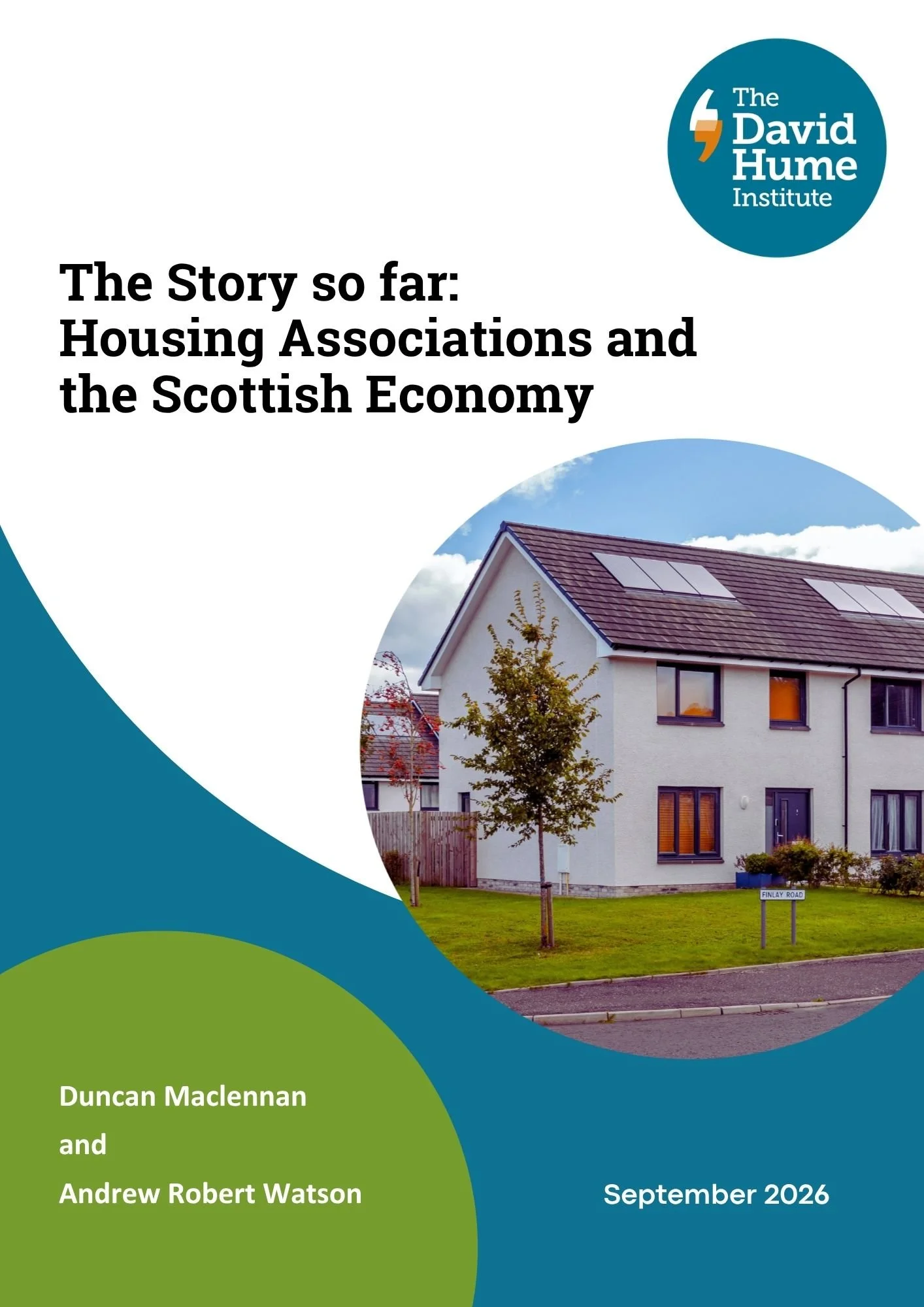
Using new evidence and analysis, this report argues that their full economic contribution is not yet properly understood or measured. As a result, housing investment is often viewed as a cost rather than as an investment capable of generating wider economic, social and public-sector returns.
Housing associations support employment, construction, local businesses, skills, regeneration and household incomes through their direct spending, supply chains and wider economic activity.
Their not-for-profit status makes this particularly significant. Rather than distributing profits to shareholders, surpluses are retained and reinvested in homes, services and communities. Where associations employ locally and procure from local businesses, expenditure can circulate within local economies, supporting jobs, businesses and further investment.
Housing also affects productivity. Affordable, secure and suitable homes can support labour mobility, help employers recruit and retain workers and enable people to participate in employment. Poor housing can create costs through ill health, homelessness, financial insecurity and pressure on public services.
The report identifies ten interconnected domains through which housing associations contribute, or have the potential to contribute, to Scotland’s economy calls for better measurement and economic modelling, including the local economic multiplier and the public costs that good housing can prevent.
The message is clear: housing associations are already creating significant economic value. Scotland needs to measure it, understand it and make investment decisions based on the full return.

Understanding Scotland Economy Tracker August 2026
Latest tracker survey reveals financial strain continues to impact people's daily lives, leisure activities and health.
Tracker survey reveals financial strain is impacting people's daily lives, leisure activities and health.
The latest Understanding Scotland Economy Tracker published by The David Hume institute in conjunction with Diffley Partnership surveyed 2,186 adults across Scotland between 2 and 5 August 2026.
The survey has been tracking public opinion and behaviour on the Scottish Economy since October 2021.
The latest esearch reveals the ongoing cost of living squeeze remains a dominant issue for Scots.
Almost half (47%) identify inflation and living costs as one of the most important issues facing the country for a second consecutive quarter.
The latest findings suggest an increasingly anxious public where financial strain is directly impacting daily life, leisure and health.
Other key findings include:
● More than two-thirds of Scots who expressed an opinion (68%) say the economy is worse than it was a year ago.
● A similar proportion (67%) expect economic conditions to worsen over the next 12 months.
● Only around a quarter of Scots (24%) believe things in Scotland are heading in the right direction.
The survey also highlights how economic pressure is shaping everyday behaviour across Scotland:
● More than half of respondents (52%) say they have reduced non-essential spending because of concerns about money matters.
● A similar proportion (51%) say they have cut back on leisure activities.
● Four in ten Scots (40%) say they have dipped into savings to meet higher costs.
● Three in ten say concerns about money have affected their mental health (30%) or caused them to lose sleep (29%).

Applications of Mathematics - a revolution in maths education in Scotland?
New briefing reveals a transformation in maths education in Scotland. Data shows the new maths qualification is attracting thousands more young people to study mathematics.
Our latest briefing examines Scotland’s Applications of Mathematics qualifications. The subject continues to experience extraordinary growth since its introduction, with entries in National 5 increasing sevenfold in seven years, and helping drive a significant rise in the number of young people studying mathematics.
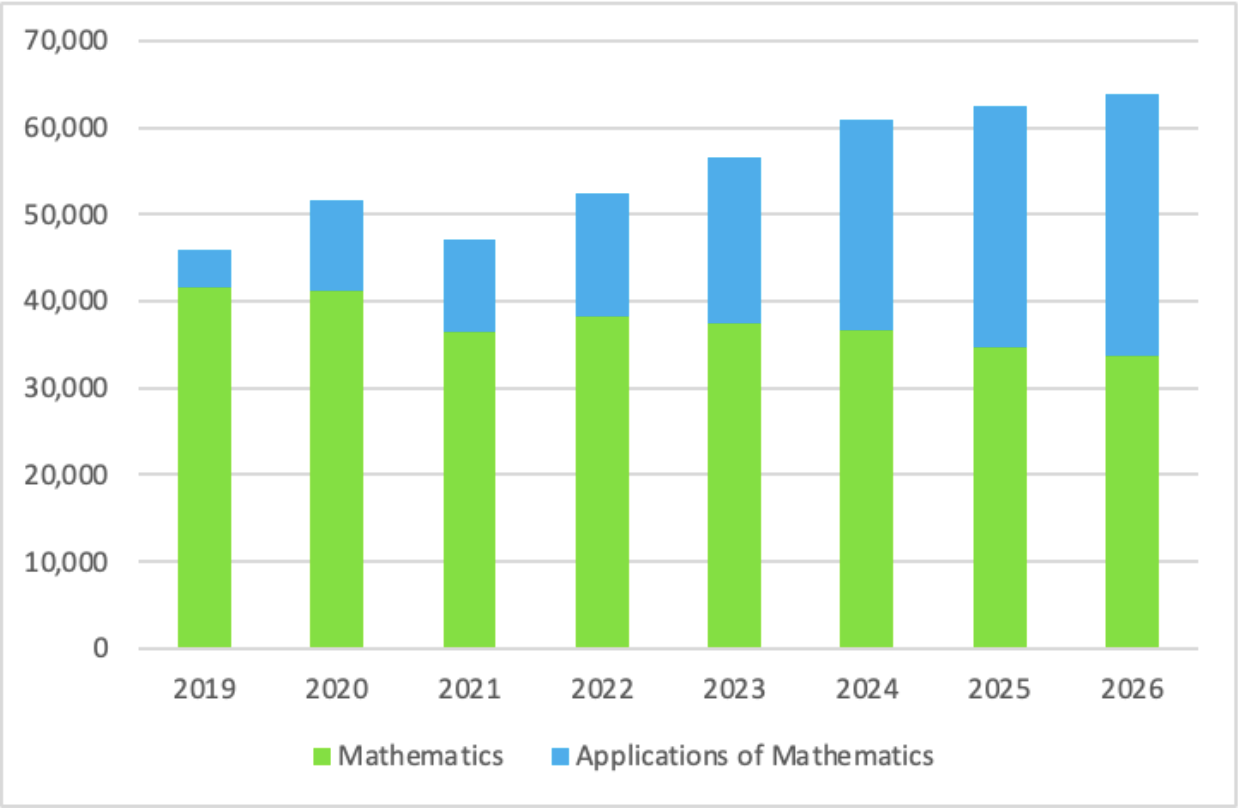
Graph to show entries into mathematics and applications of mathematics at National 5 from 2019 to 2026
The briefing, Applications of Mathematics: A Revolution in Maths Education in Scotland?, shows that National 5 Applications of Mathematics entries rose from just 4,460 in 2019 to 30,045 in 2026.
The qualification is now the third most popular National 5 examination in Scotland, behind only English and traditional Mathematics. Together, Applications of Mathematics and traditional Mathematics have resulted in an increase of almost 40% in the total number of entries into a National 5 maths qualification.
The paper argues that the qualification represents an important innovation in Scottish education by focusing on practical mathematical skills that young people use in everyday life - including budgeting, taxation, personal finance, loans, interest rates and interpreting data - while also supporting the skills increasingly sought by employers in sectors such as financial services and data science.
Overall participation in mathematics has increased by more than a third and rather than replacing traditional mathematics, the evidence suggests the qualification is broadening participation. Some pupils are choosing to study both qualifications.
As conversations continue around financial literacy, workforce skills and curriculum reform, the paper concludes that Applications of Mathematics offers an important piece of the jigsaw for how education can better connect classroom learning with real-world challenges and future employment.

Understanding Scotland Economy Tracker - May 2026
Read the latest Insights from the May 2026 Understanding Scotland Economy Tracker, find out what people think now the Scottish Parliament election is over
Published: 25th May 2026
The findings of the first Understanding Scotland Economy Tracker since the Scottish Parliament Election bring into focus the scale of the challenge facing the new MSPs.
Despite growing confidence in the country’s direction, economic sentiment has plummeted, with the cost of living now the number one issue for the majority of Scots.
Cost of Living Once Again the Defining Issue
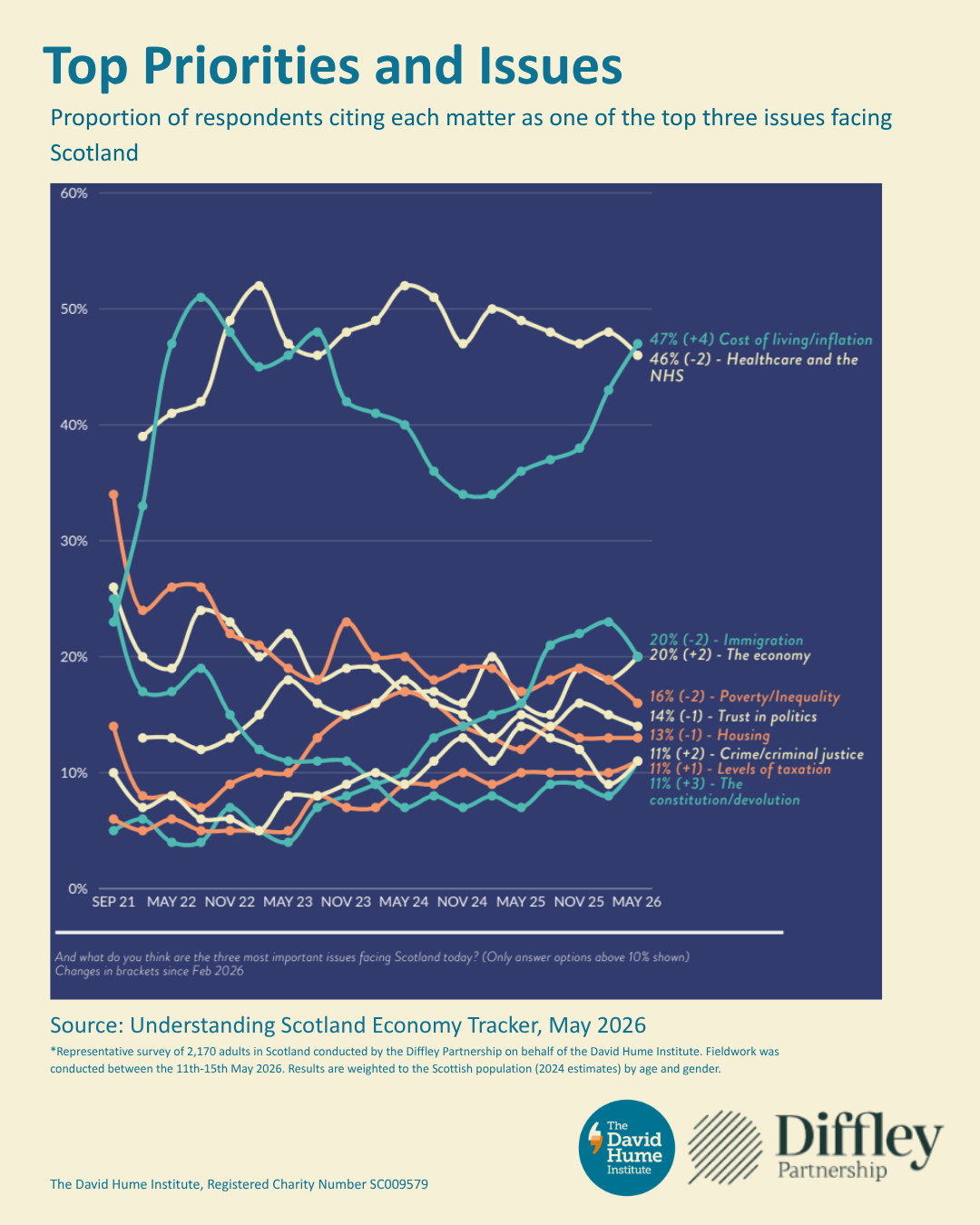
For the first time in nearly three years, the cost of living has overtaken the NHS as the single biggest concern facing Scots. Almost one in two (47%) now rank it among the top issues facing the country, according to the latest quarterly survey, conducted by Diffley Partnership on behalf of the David Hume Institute.
Public concern about the cost of everyday life has increased considerably in the year to date, with the 9% increase since November 2025 (37% to 48%) the sharpest increase of public concern for any issue since late 2021. By contrast, campaigning during the election period seems not to have had much impact in shaping Scot’s priorities.
Limited Economic Confidence Collapses
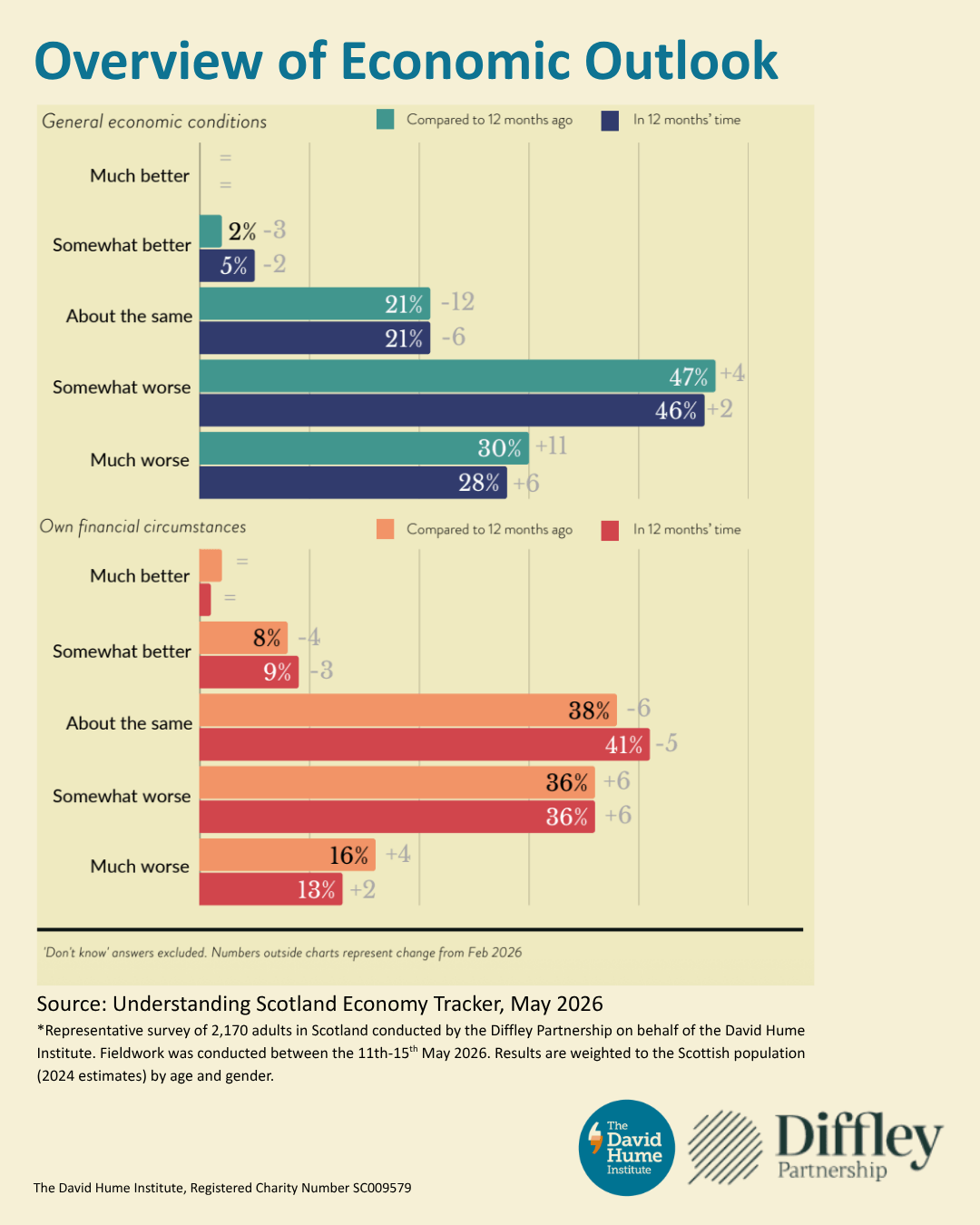
Scots are extremely pessimistic about the future of the economy. Minimal waves of optimism indicated in February’s quarterly survey have been washed aside.
More than three in four Scots (77%) now say the economy is worse than a year ago, up sharply from around three in five (62%) in February. Notably, three in ten Scots (30%) report feeling that the economy is ‘Much Worse’ than it was a year ago, a considerable 11% increase since February.
But while most (73%) expect economic conditions to deteriorate in the next twelve months, a majority (51%) also expect their own financial circumstances to remain the same or improve in year ahead.
Growing Pressures on Consumer Spending
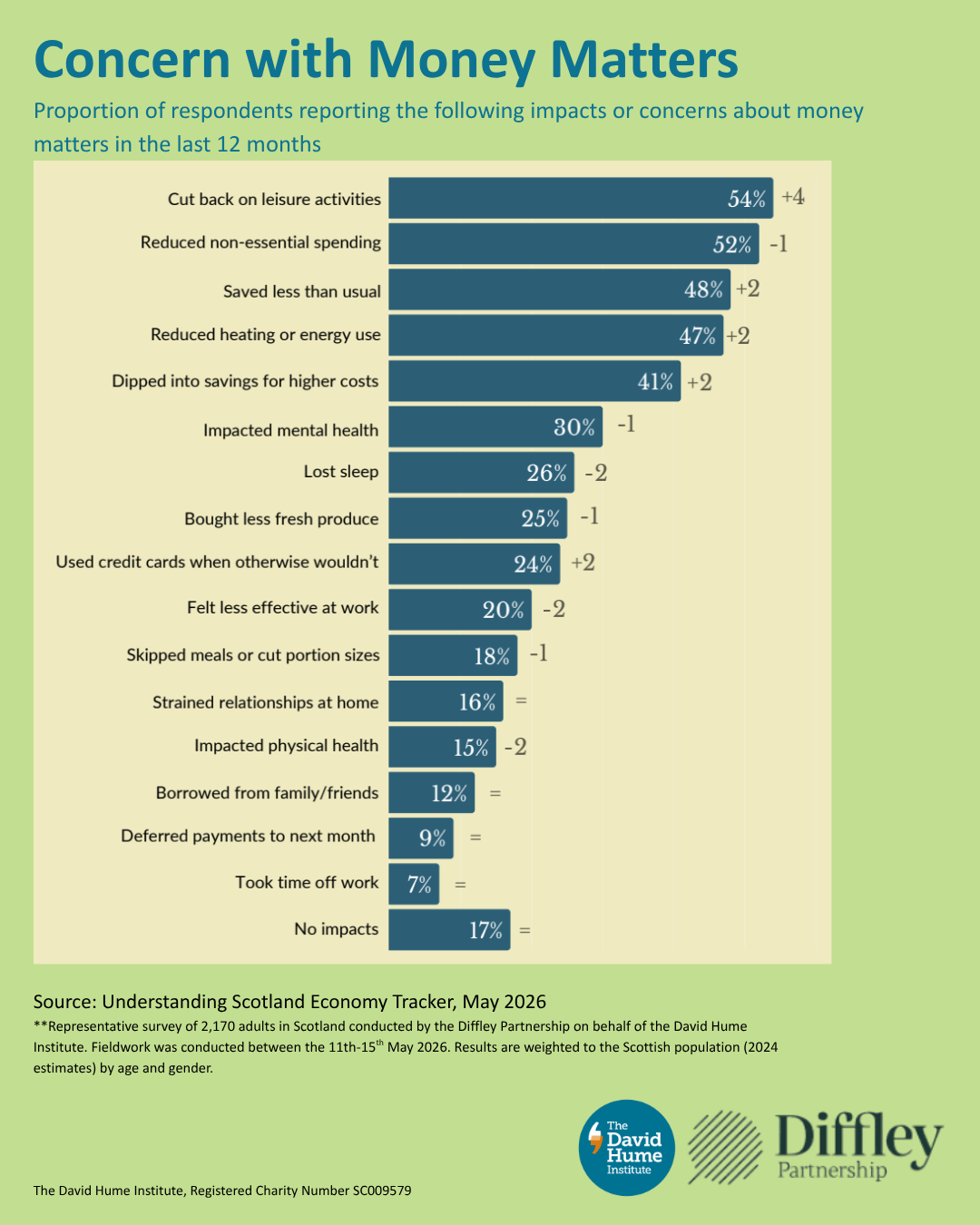
Cost of living concerns are not just shaping perspectives on the wider economy, they are affecting behaviour within it. More than half of respondents (54%) have cut back on leisure activities because of concerns about money. This is a 4% increase since the last quarterly tracker in February.
A similar proportion (52%) have reduced non-essential spending. Over two in five Scots (41%) report using savings to cover higher costs.
Scots Support Preventative Action
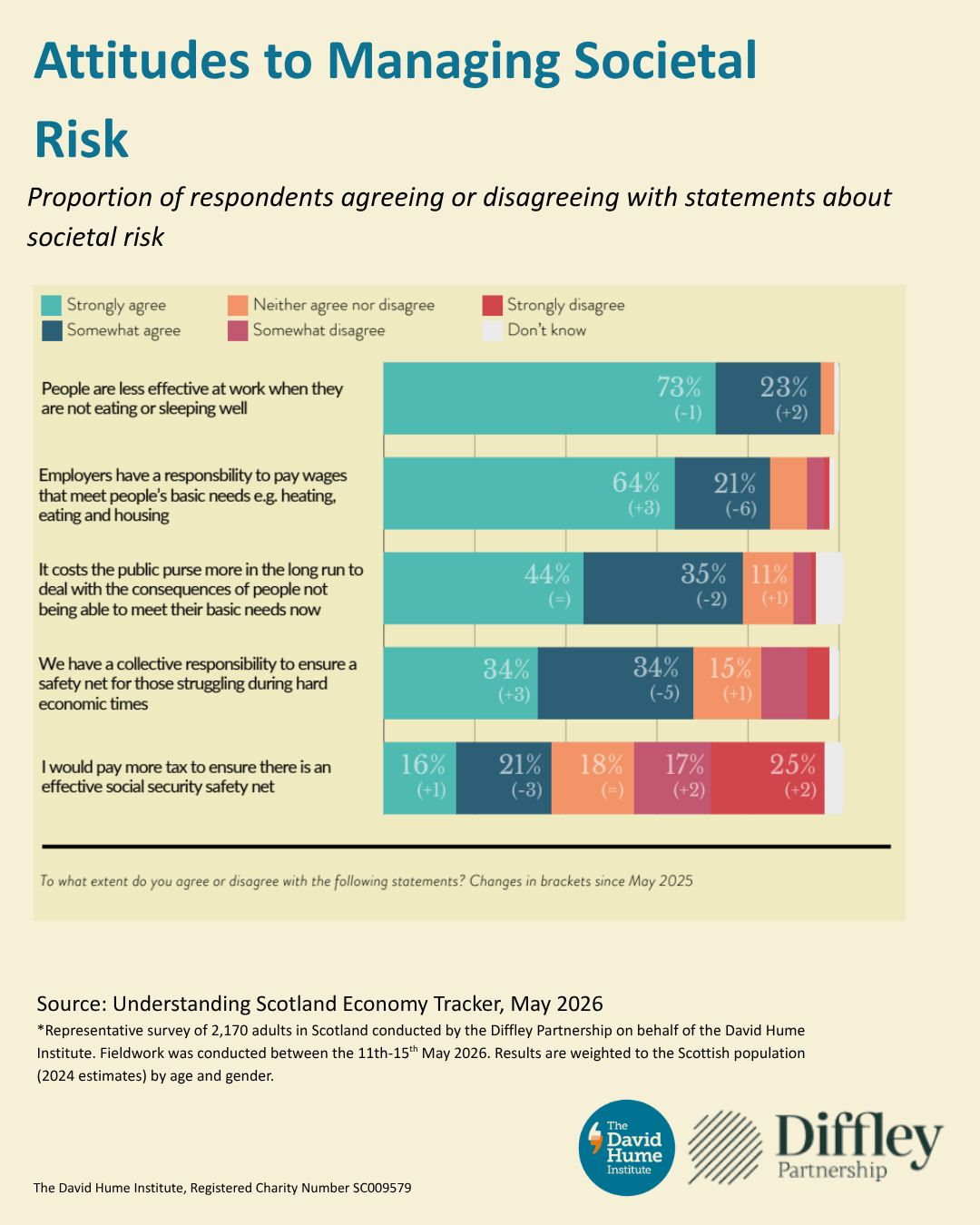
As decision makers seek to rebuild economic confidence, new data from the tracker indicates that the overwhelming majority of Scots continue to support preventative action to tackle economic hardship.
Nearly four in five (78%) Scots agree it costs the public purse more in the long run when people cannot meet their basic needs today. Over two thirds (68%) also agree there is a collective responsibility to ensure a safety net during hard economic times.

Understanding Scotland Economy Tracker - February 2026
Insights from the February 2026 Understanding Scotland Economy Tracker, how is the economy affecting people’s lives in Scotland, what will it mean for the election?
Published: 25th February 2026
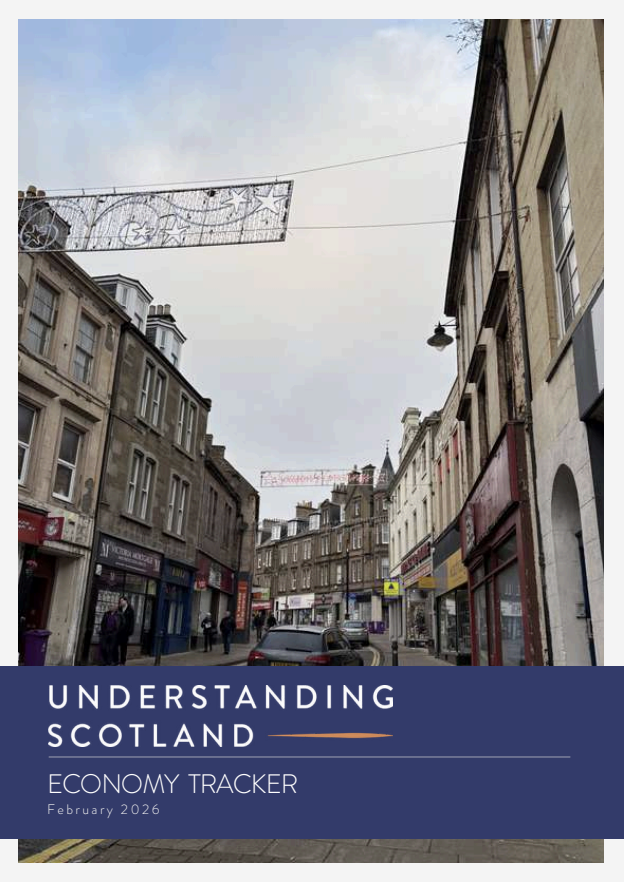
The final Understanding the Scotland Economy tracker before the May Scottish Parliament elections shows how Scots are experiencing the economy and what they want to see prioritised in party manifestos.
While pessimistic economic sentiment has softened slightly since November, financial strain remains and the cost of living looks likely to remain salient to the campaign ahead.
Pre-Election Priorities
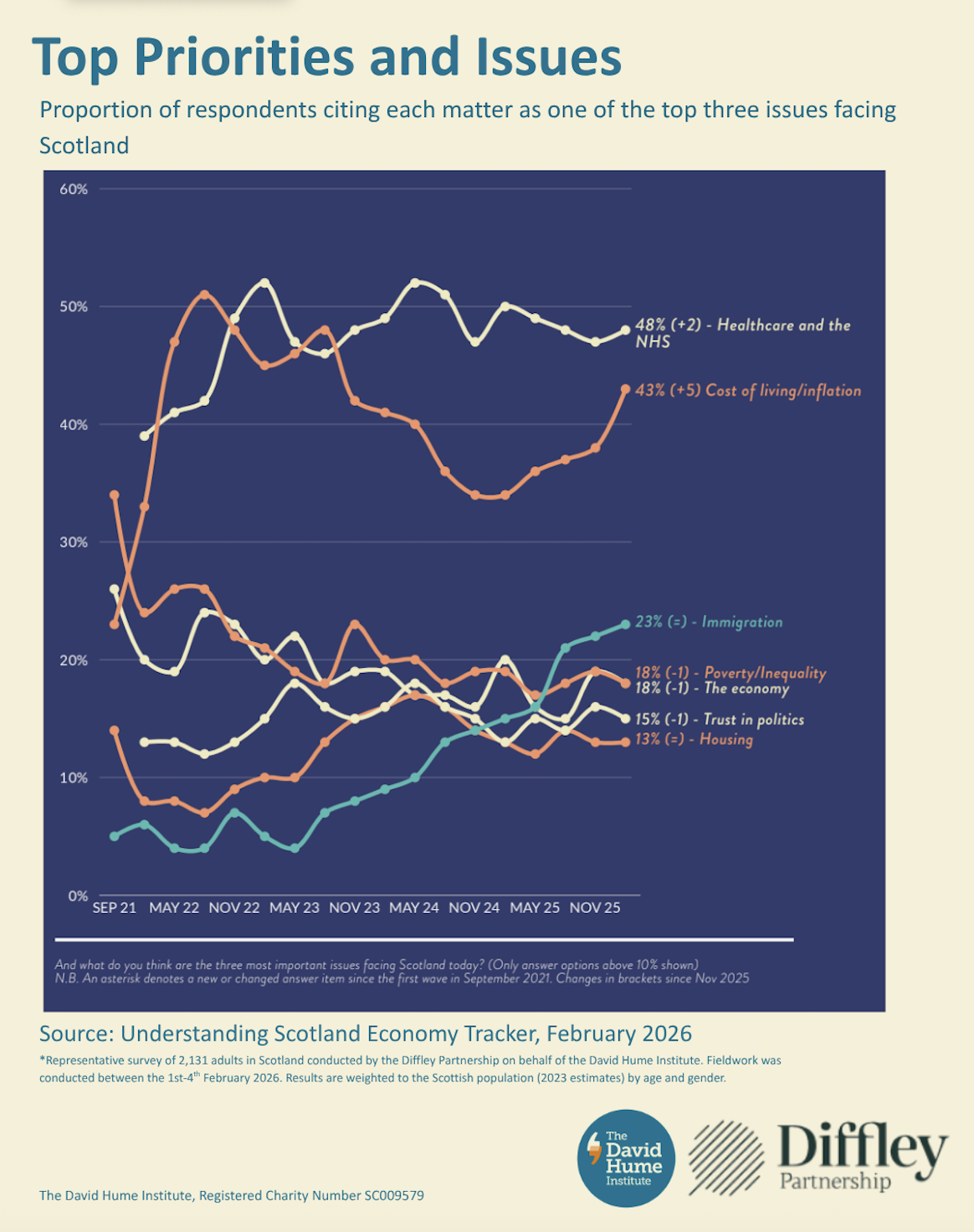
The last tracker before the Scottish Parliament elections reveals that the cost of living and the NHS remain the most important issues to voters. Half (48%) of respondents to the survey, commissioned by the David Hume Institute and produced by the Diffley Partnership, cite healthcare and the NHS as a top priority. Near half (43%) said that the cost of living and inflation should be a national priority, a five percent increase since the most recent quarterly tracker.
Economic Pressures Easing Slightly
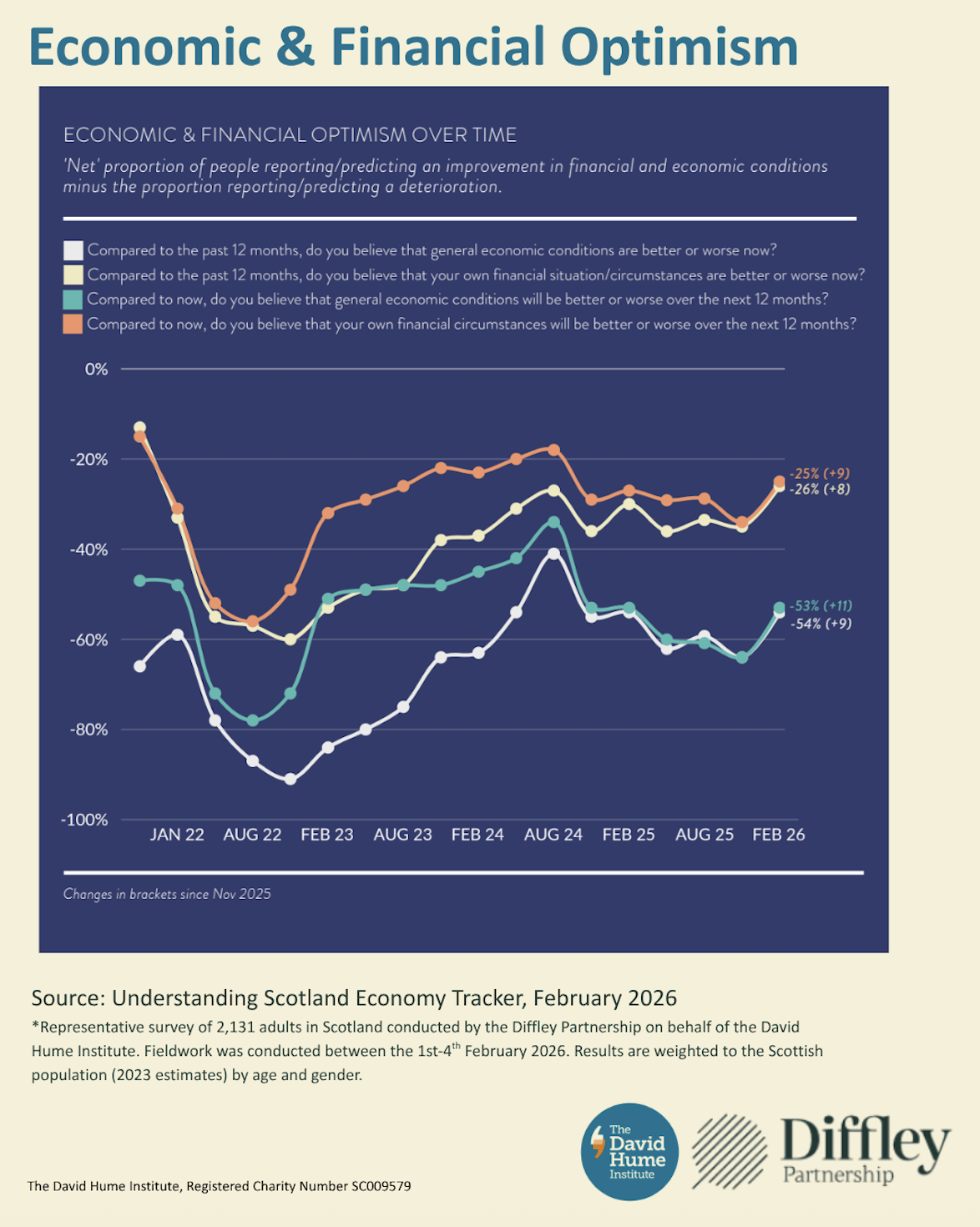
Pessimism still dominates the overall economic outlook, with less than one in ten (7%) thinking economic conditions will be better in a year than today. However, sentiment is markedly less pessimistic than it has been across the past two years.
For instance, while three in five (62%) think that general economic conditions are worse now than they were a year ago, this is a seven percent drop since November. Looking ahead, two in three (66%) expect conditions to worsen in the next twelve months, down from three in four (73%) previously.
Financial Strain Remains
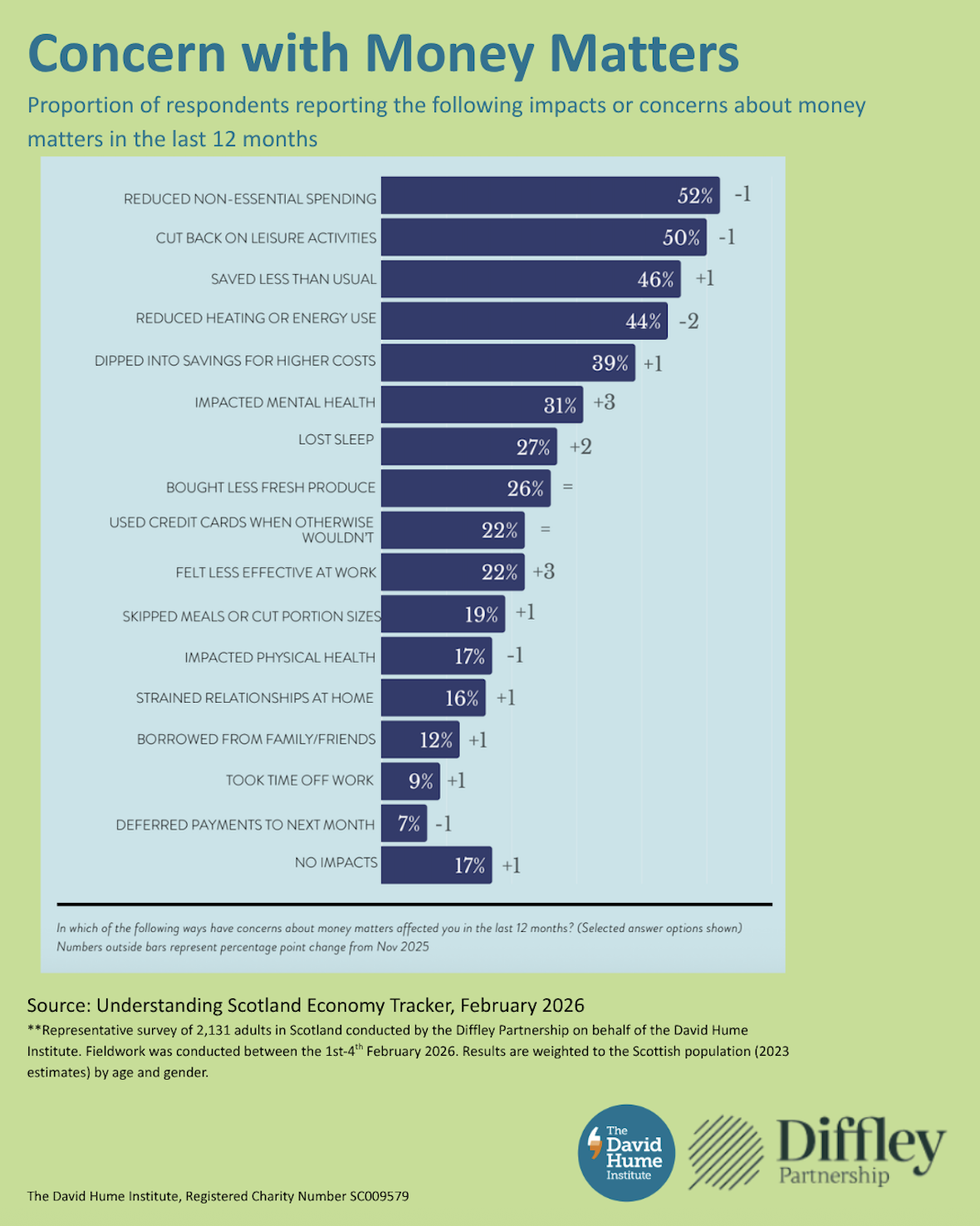
While overall economic sentiment has improved at the start of the year, financial strain is still widespread and penetrating the actions and spending of everyday life for many. The majority (52%) report recently cutting non-essential spending, while nearly one in three (31%) say that money worries are impacting their mental health, a three percent rise and among the highest rates since the tracker began.
Looking ahead, concerns about essential costs increasing remain. In the year ahead, over two thirds (69%) expect higher utility bills, one in two (50%) expect to spend more on food and drink and around the same (49%) anticipate spending more on their housing.
Scots sceptical about how the economy works
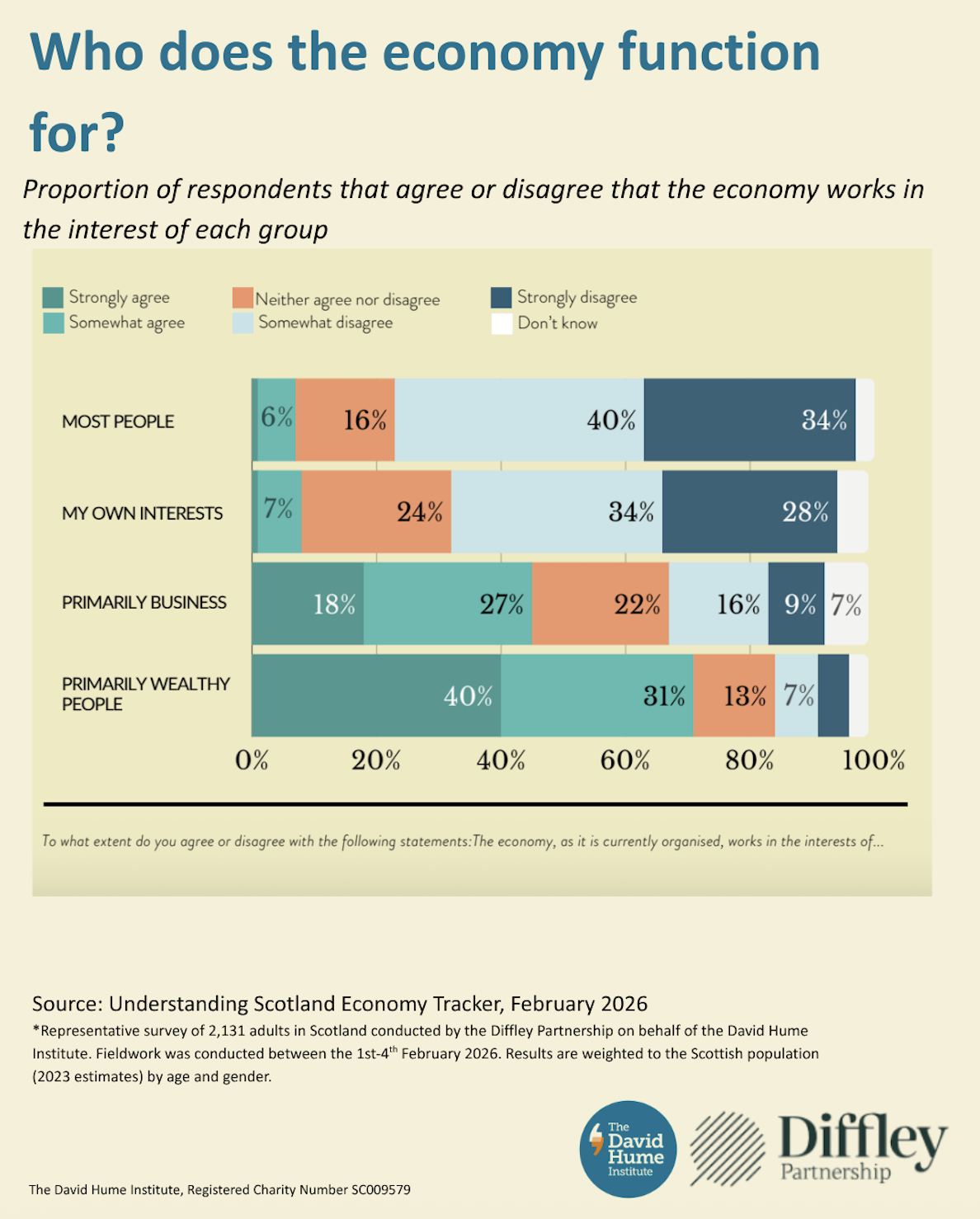
New data from the tracker indicates that whoever forms the next Government may need to focus on rebuilding faith that Scotland’s economy can work in the interests of the majority of the people that live here. Seven in ten (71%) believes the economy works primarily in the interests of the wealthy, while just one in fourteen (7%) believes the economy works for most people. Just one in twelve (8%) thinks the economic system works for them.

Understanding Scotland Economy Tracker - November 2025
Insights from the November 2025 Understanding Scotland Economy Tracker, how is the economy affecting people’s lives in Scotland?
Published 23rd November 2025

The latest Understanding Scotland Economy Tracker reveals low optimism about the economy and highlights how these concerns are shaping everyday life.
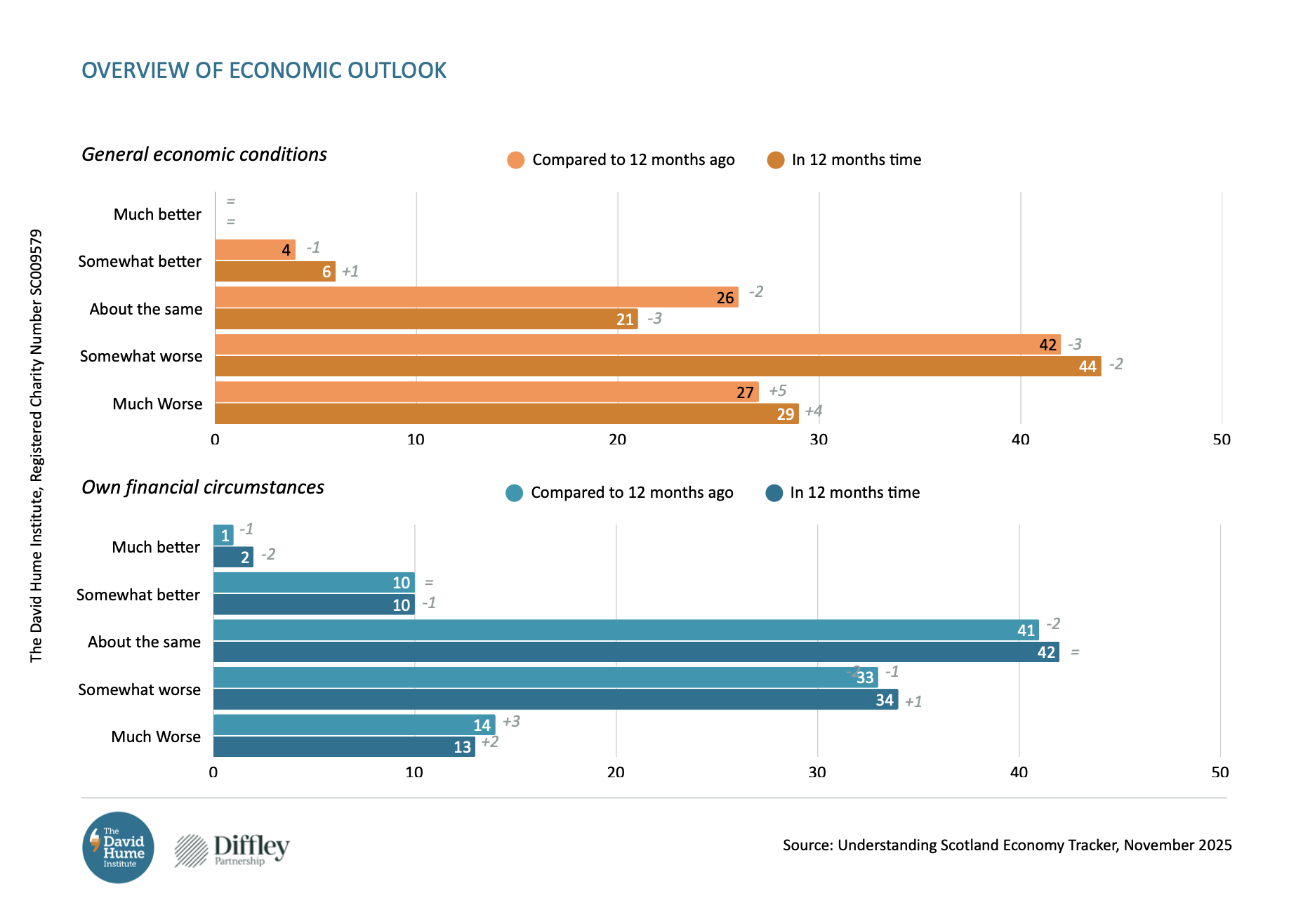
With the Scottish Parliament election half a year away, seven out of ten Scots (69%) say that economic conditions are worse today than a year ago.
This quarterly survey, commissioned by the David Hume Institute and produced by the Diffley Partnership, is the final wave of 2025. A summary of key findings in the report is presented below.
Pessimistic Economic Outlook
As the UK budget looms, pessimism about the economy has increased since the last survey, with nearly three quarters (73%) of respondents expecting conditions to worsen in the year ahead. Overall gloomy sentiment has hardened, with the proportion of respondents reporting a deterioration of general economic conditions at its highest rate since November 2023.
Households Bracing for Pressures Ahead
New data revealed in the latest tracker demonstrates the impacts that concerns over Scotland’s economy bring households across the country.
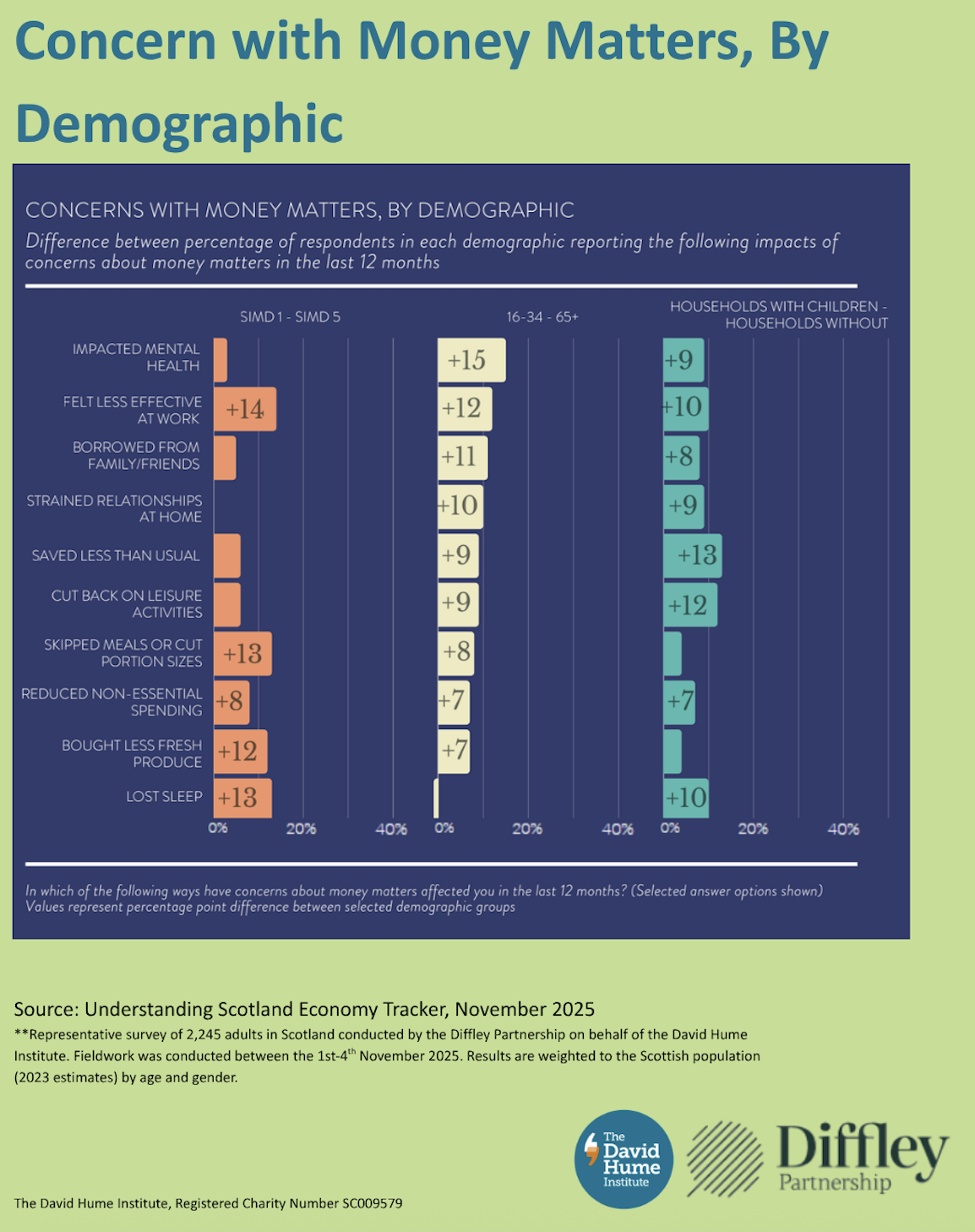
Four out of five (84%) report some form of negative impact to their everyday life from concerns about money in the past year. With the winter months underway, one in five Scots (18%) report impacts to their physical health from money matters and nearly half (47%) say financial concerns have reduced their heating use in the past year.
The tracker also indicates that younger people and those with children are more likely to report significant impacts to everyday life from money concerns. Households with children are nearly 10% more likely to report negative changes in behaviour and spending habits than those without. There is a similar difference between younger people (16-34) and older people (65+).
Low Labour Market Expectations
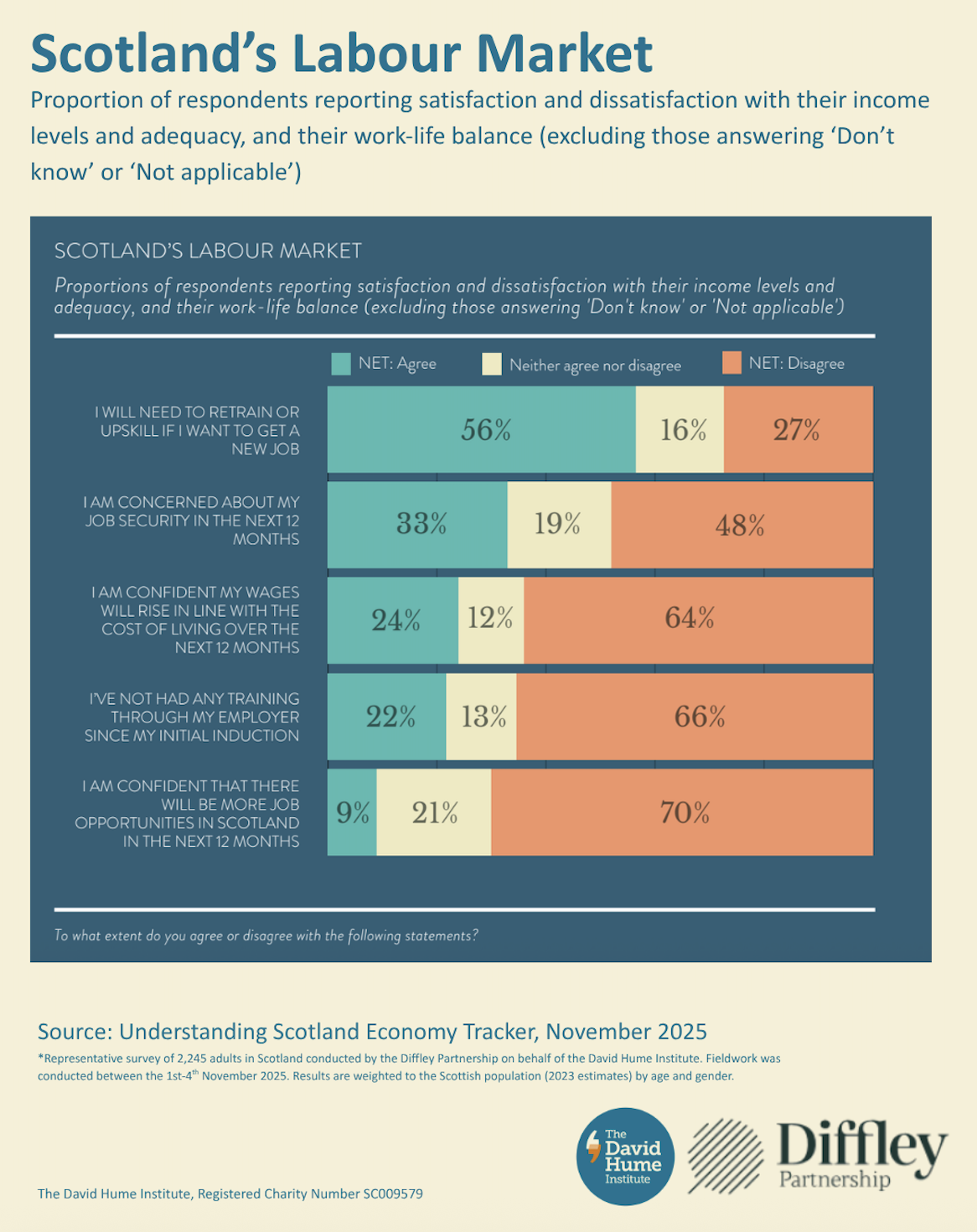
Heading into a new year, expectations for the labour market in the next twelve months remain low. Fewer than one in ten (9%) agree there will be more job opportunities in the year ahead, with seven in ten (70%) disagreeing.
Data from the tracker also demonstrates underlying concerns about preparedness for any new roles. While a majority of respondents (56%) think they would need to retrain or up-skill to get a new job, nearly a quarter (22%) report receiving no training in their current job since their initial induction.

Understanding Scotland Economy Tracker - May 2025
Read insights from the May 2025 Understanding Scotland Economy Tracker, what do people think about the economy and how is affecting their life in Scotland?
Published 27th May 2025


Economic Outlook

The latest Understanding Scotland Economy Tracker highlights the precarious financial position of many Scots. Significant numbers of people are just one unexpected bill away from crisis.
1 in 5 Scots cannot cover an emergency expense of £100 without borrowing money
This figure doubles to 44% for a £500 emergency, demonstrating a widespread lack of financial resilience.
Overall there is an increase in people believing that both general economic conditions and their own financial circumstances will get worse in the coming 12 months.
Top priorities and issues

The latest survey found that healthcare and the cost of living remain as the most pressing issues, cited by one in two and one in three respectively. The next most cited issue is poverty (17%).
However, for the first time since the tracker began in October 2021, immigration has joined the top five public concerns. Immigration is now ranked as a top issue by 16% of Scots - up six percentage points since May 2024 and is now equal with the economy.
The top five priorities listed by survey respondents are:
Healthcare 49%
Cost of living 36%
Poverty 17%
Immigration 16%
Economy 16%
More insights from the research


Understanding Scotland Economy Tracker - February 2025
Our latest independent economic tracker reveals the economy is emerging as a key priority as 62% of Scots say conditions have worsened in past year.
Published Monday 24th February 2025
Our latest independent quarterly tracker has revealed the economy is emerging as a key priority as 62% of Scots say conditions have worsened in past year.
Key findings:

Health care and the cost of living remain top priorities, with the economy emerging as a high priority for Scots
Healthcare continues to dominate as the most pressing issue for Scots, increasing by four percentage points to 50% naming it as a priority. Cost of living remains stable at 34%. Meanwhile, the proportion identifying the economy as a priority has risen by four percentage points to 20% after hitting a low of 16% in November 2024.
Glimmers of optimism as more Scots see the country heading in the right direction
While 53% of Scots still believe the country is heading in the wrong direction, this is down three percentage points from the last wave. At the same time, optimism is growing, with 24% now saying Scotland is on the right path - an increase of four percentage points. Meanwhile, 23% remain uncertain, with optimism narrowly overtaking uncertainty for the first time in recent waves.
Economic outlook remains bleak
A majority of Scots (62%) say economic conditions have worsened over the past year, and 64% believe they will deteriorate further in the next year. While this marks a slight decline of one to two percentage points in pessimism since the last wave, optimism has not grown, with fewer than one in ten reporting an improvement in the last year or predicting an improvement over the next year.
Cost-cutting becomes routine but financial strain hits some harder
Spending cutbacks remain widespread, with 53% of Scots reducing leisure activities, 52% cutting non- essential spending, and 45% saving less than usual—figures that have changed little since November 2024. However, financial strain is more pronounced among Scots aged 16-34, those in lower social grades, households with children, and ethnic minorities, particularly affecting their mental health, physical well-being, and sleep.
Signs of recovery for some sectors but non-essential spending cuts persist
Spending reductions are expected to continue this year, particularly in dining out, with 45% cutting back on takeaways and deliveries and 43% on restaurants. However, there are small signs of recovery in certain areas: the proportion expecting to spend more on clothing and footwear is up five percentage points, while leisure and culture and holidays outside the UK have seen increases of three percentage points each.
Three key graphs from the report below.

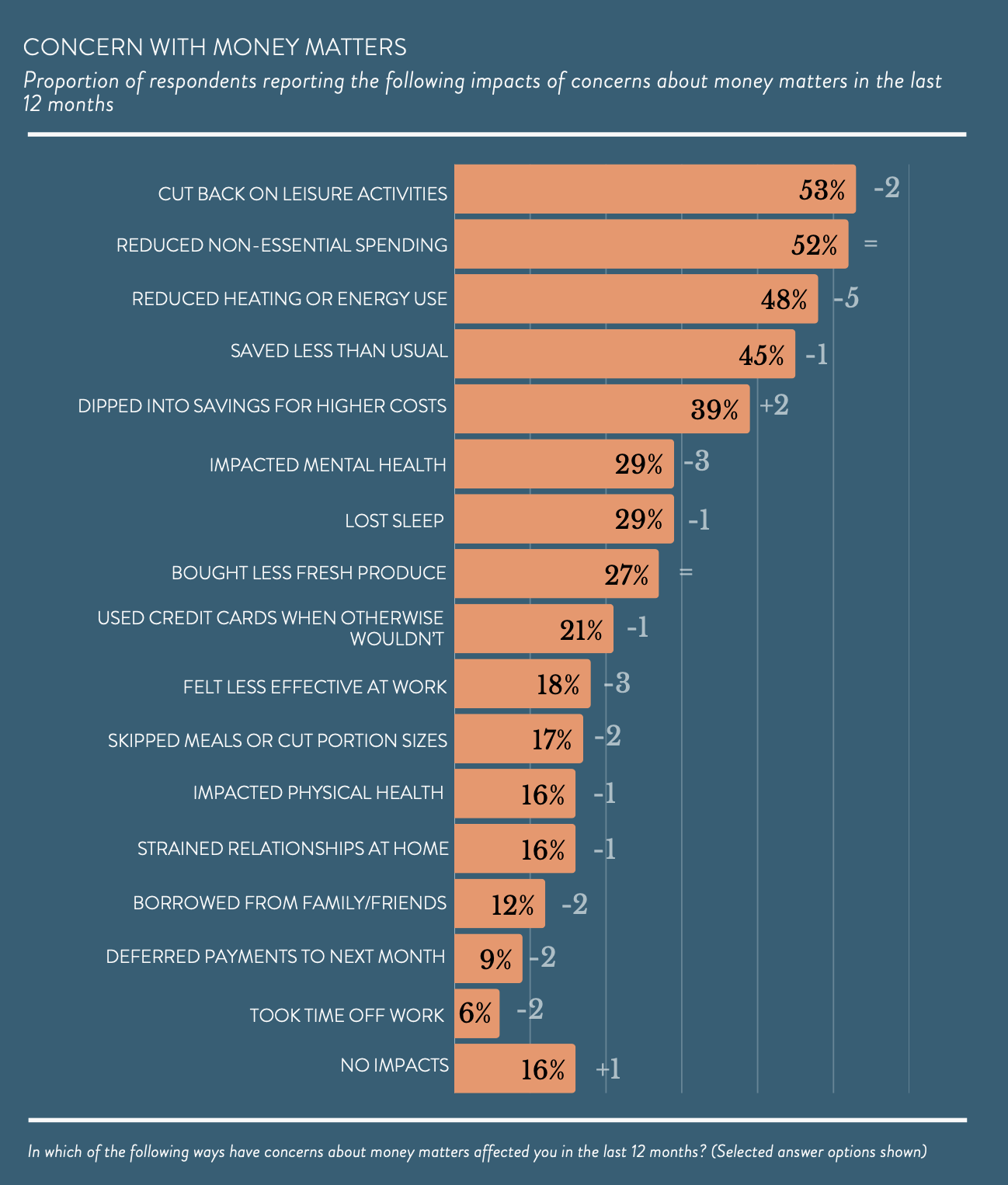

Image credit: Sharing thumbnail image and report front cover by Sinitta Leunen, free licence from Unsplash 23.02.25
Understanding Scotland Economy Tracker - November 2024
Our quarterly economic tracker from a panel of over 40,000 people in Scotland reveals green shoots of optimism in August have faded and poses big questions ahead of the Scottish Budget.
Our independent quarterly tracker has revealed that 48% of people living in Scotland believe their financial situation is worse than a year ago.

Since August 2024, there has been a six percentage point rise in people feeling that their own finances have worsened in the last year – with 3 in 10 people (29%) admitting they have lost sleep over money.
While 63% believe that the general economic conditions are worse, up nine percentage points, 65% of people said they believe that the general economic conditions will continue to decline, up 13 points on the last quarter.
The latest results for the Understanding Scotland Economy Tracker, from the David Hume Institute and polling experts Diffley Partnership, suggest a growing lack of optimism over the last three months and pose big questions for Shona Robison ahead of the Scottish Budget.
The latest edition of the survey from November 2024 shows that:
More than 1 in 6 people (17%) report strained relationships at home because of money
1 in 6 Scots (16%) report an impact on their physical health due to worries about money
1 in 3 people (32%) report an impact on their mental health due to worries about money
Only 15% say that concerns about money matters have not affected them
3 out of 4 people (75%) believe the economy works primarily in the interests of wealthy people
However, there is not a complete lack of optimism with younger Scots more likely to believe that their financial fortunes will turn. Those aged between 16 and 34 appear more optimistic with 25% saying they believe their own economic situation will get better. This compares to just 6% of 45 to 54 year-olds, 8% aged 55 to 64, and 5% of over 65s.
When looking at the policy priorities for Scots, healthcare and the NHS remains the top priority of Scots with nearly half (47%) citing this as one of the top three issues facing Scotland. A third (34%) cite cost of living and inflation, this has declined eight percentage points from November 2023. One in five (19%) put poverty/inequality among the top three issues facing Scotland.
Understanding Scotland Economy Tracker - August 2024
Our quarterly economic tracker from a panel of over 40,000 people in Scotland reveals green shoots of optimism appearing
29th August 2024

Our independent quarterly tracker has revealed that one in three (36%) people living in Scotland consider the cost of living as one of their top concerns, down 12% on this time last year.
According to the Understanding Scotland Economy Tracker from the David Hume Institute and polling experts the Diffley Partnership, while concern about the cost of living has fallen, healthcare remains the key concern for the public, selected by over half (51%) of respondents as a key worry.
The data was collected at the start of August, a month after the General Election, against a backdrop of economic insecurity, mounting concern about public expenditure and a wave of anti-migrant riots.In our first survey since the General Election, data reveals some green shoots of optimism.
Over half (54%) of people in Scotland believe that general economic conditions are worse now than a year ago - a considerable fall from the 2 in 3 (66%) that agreed with this statement in May.
1 in 3 (35%) of those that express an opinion believe that general economic conditions are about the same as they were in August of last year, an increase of 11%.
15% of households with children say they feel better off than a year ago, compared to 10% reporting the same in August 2023 and 9% in August 2022.
Read more:
Press Release - Green shoots of optimism as fewer Scots concerned by cost of living
David Gow's Blog - Are we singing a new song?
Watch the event recording here.