National Progression Awards have trebled in Scottish schools since 2022, but major gaps in recorded subject attainment and uncertainty over university recognition raise questions about whether every young person can benefit from a broader curriculum.
Published: 5th November 2026
Scotland's drive to broaden the senior phase school curriculum risks creating a two-tier system of opportunity unless young people can access a meaningful range of subjects and are confident that their qualifications will be recognised by universities, colleges and employers, new research from the David Hume Institute warns.
The report, Unequal Pathways? Access to National Progression Awards in Scotland, finds that the number of National Progression Awards (NPAs) recorded through Scottish schools has more than trebled, rising from 11,110 in 2022 to 33,735 in 2026.
School-delivered awards now account for more than three-quarters (77%) of all recorded NPA awards, compared with 57% four years ago. This represents a significant shift towards practical and applied qualifications being delivered within the school system.
But the research identifies striking geographical differences in the range of NPA subjects with recorded attainment in schools. In 2026, the number of distinct subjects recorded ranged from just one in Shetland to 55 in both Edinburgh and Fife. The national median was 31.5 subjects per local authority.
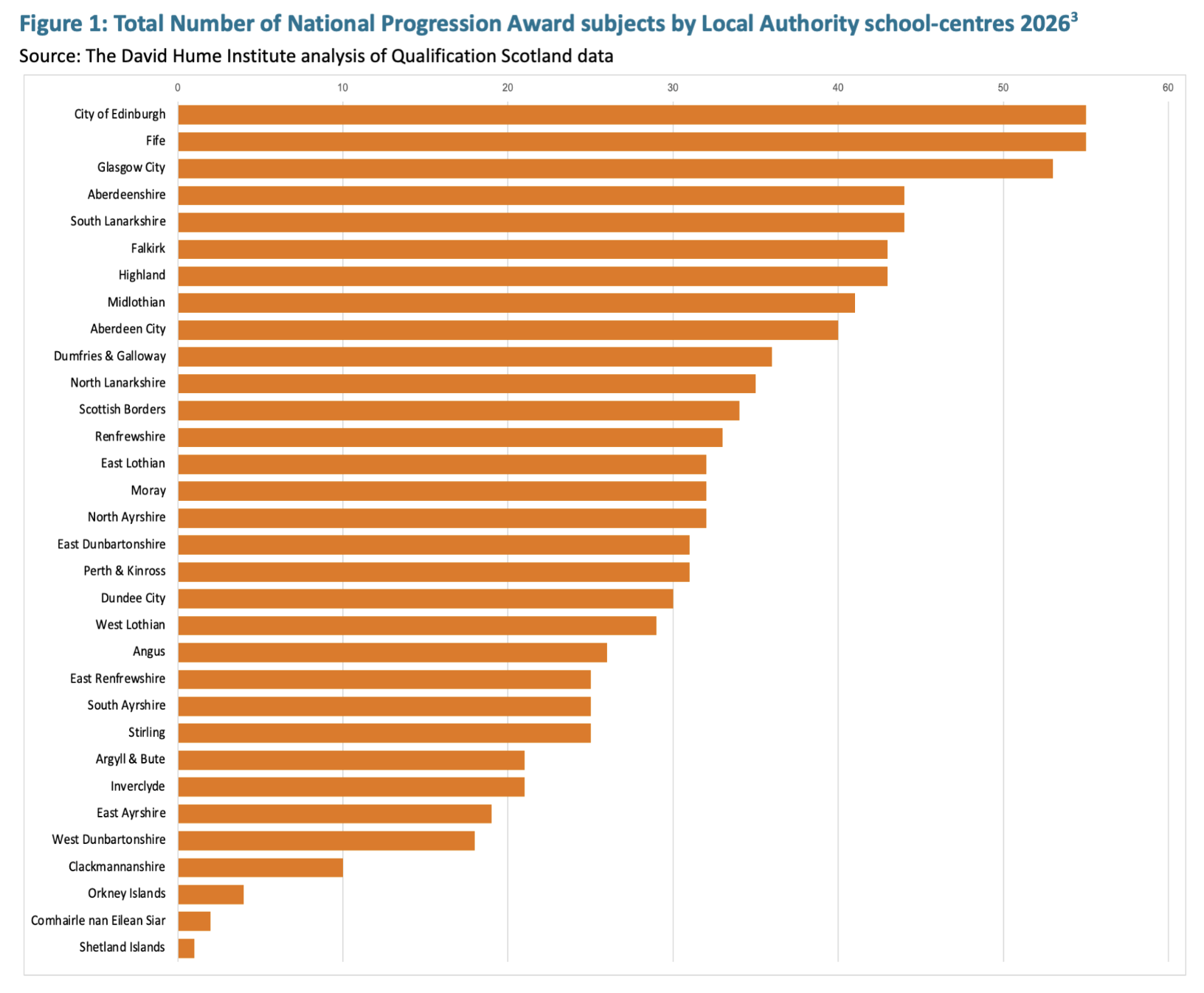
These figures do not prove that pupils in areas with fewer recorded subjects have less access. NPAs may also be delivered through colleges and partnership arrangements, which are not possible to fully capture in the geographical analysis. However, with 267 possible NPA subjects across different levels and educational settings, the absence of a comprehensive national picture makes it difficult to establish whether young people have genuinely equal opportunities.
The findings raise important questions about how Scotland will deliver the ambitions of the Hayward Review of Qualifications and Assessment, which called for all senior phase learners to have an entitlement to a broad range of academic, vocational, professional and technical learning.
Ellie Craig, lead researcher on the briefing, said:
"Scotland has made real progress in broadening the qualifications available to young people. The growth in National Progression Awards shows that schools are embracing different ways for pupils to develop practical skills and explore subjects beyond the traditional academic curriculum.
"But the number of qualifications being delivered is not the same as equality of opportunity. We need to know what young people can actually access, whether they can travel or connect to provision elsewhere, and whether the qualifications they work hard to achieve will be recognised when they move on.
"Flexibility is essential to a modern senior phase. But it must expand young people's choices, not leave their opportunities dependent on where they happen to go to school or live."
A broader curriculum is an economic growth issue
The research comes at a critical time for Scottish education and the economy. The Hayward Review proposed a more flexible senior phase, with a wider range of academic, vocational, professional and technical courses.
The growth of NPAs suggests that elements of this broader approach are already taking shape. The challenge now is to ensure that curriculum flexibility translates into meaningful opportunities for learners and the skills Scotland needs.
Scotland's future economic performance will depend in part on its ability to develop a workforce with the technical, digital, creative and practical capabilities required by changing industries. Young people need opportunities to develop those skills, while employers and universities need to understand the value of the qualifications through which they are demonstrated.
The report highlights the growing importance of subjects such as data science, artificial intelligence and cyber security. Yet recorded school attainment in Data Science was present in only eight of Scotland's 32 local authorities in 2026.
The research also finds that further education colleges recorded 285 Data Science awards at SCQF levels 4–6, in addition to 155 through school centres. This illustrates both the importance of college provision and why a school-only picture cannot tell the whole story.
Ellie Craig added:
"Implementing the Hayward Review is not simply about giving young people more qualifications to choose from. It is about developing the skills Scotland's economy will need in the future.
"Businesses need people with a wider range of capabilities, including digital, technical and problem-solving skills. If Scotland wants to become more productive, innovative and competitive, we need to make sure young people can access these learning opportunities and that employers and universities understand the value of the qualifications they achieve.
"Where a young person lives should not determine the range of skills they can develop or whether those skills are recognised."
Young people need to know their qualifications will count
The report also identifies uncertainty about how universities recognise NPAs in their admissions processes.
Some universities accept particular NPAs towards entry requirements for specific degree courses, but recognition varies by institution, subject and qualification. The Institute argues that learners, parents and teachers need clearer information about how individual awards contribute to progression into higher education and other destinations.
The issue is not simply theoretical. One current S5 pupil who spoke to the researchers described feeling dismissed when asking university admissions staff whether their Level 6 NPAs would be recognised.
Adam said:
"I've been to a couple of open days this year. I've got good grades at Nat 5 and took NPAs alongside my other subjects. I am doing the same with my Highers as I love the NPA subjects.
"But I felt completely dismissed by admissions staff at the two universities I have visited, when I asked if they recognised level 6 NPAs for UCAS points. When I spoke to the Head of Sociology and Criminology at one university, he said he had no awareness of how the Criminology NPA is treated by their admission process. At the other university, they said they would ignore my NPAs."
The findings are also relevant to the forthcoming final report of the UK Government's Milburn Review into Young People and Work, which is examining the reasons behind rising numbers of young people not in education, employment or training.
The review is taking a wider look at the relationship between education, skills, health, welfare and employment. The David Hume Institute's research highlights one important part of that picture: young people need access to relevant learning opportunities, and clear routes from those opportunities into further study, training and work.
Jocelyne Fleming of the Chartered Institute of Building (CIOB) said:
"National Progression Awards are an integral part of Scotland's education and skills landscape, and the geographical variation highlighted by the David Hume Institute raises important questions about equity of opportunity.
"Greater transparency would also help us understand whether the pathways available are working for learners, employers and Scotland's future skills needs. At a time when sectors including construction face significant workforce challenges, we need to understand not simply which qualifications are being delivered, but how they connect to further training, apprenticeships and employment."
The Institute argues that stronger relationships between schools, colleges, universities and employers are essential if Scotland for better opportunities for young people and a more productive economy.
Four recommendations to make pathways clearer and fairer
The report calls on the Scottish Government to work with local authorities, schools, colleges, Qualifications Scotland, the SCQF Partnership and universities to:
Improve transparency: Publish a consistent national picture of NPA provision and attainment across schools, colleges and partnership arrangements.
Support collaboration: Evaluate regional, online and college-school delivery models to extend access to specialist subjects, particularly where local capacity is limited.
Clarify progression: Work with universities and colleges to publish clear, course-specific information about NPA recognition and entry requirements.
Monitor equity and emerging skills: Develop indicators to identify geographical differences in provision and participation, including whether staffing, resources or delivery arrangements constrain access to specialist and emerging-skills subjects.
The report concludes that the objective should not be to make every school's curriculum identical, but to ensure that local flexibility expands opportunity rather than inadvertently limiting it.
Ellie Craig said:
"Scotland is building a more flexible and relevant senior phase that recognises different talents and prepares young people for a changing economy.
"The priority now should be to understand where provision is working, where barriers remain and how successful approaches can be shared. Listening to young people about their experiences must be central to that work.
"Every young person should be able to make informed choices about their future, with confidence that the learning they undertake will be recognised and valued."
ENDS
Notes to editors
Unequal Pathways? Access to National Progression Awards in Scotland is a research briefing by the David Hume Institute, authored by Ellie Craig and Susan Murray.
The research analyses Qualifications Scotland provisional attainment statistics for 2022–2026.
The geographical analysis counts distinct NPA subjects with recorded school-centre attainment in each local authority. It does not include FE college-centre attainment in the geographical comparison and therefore does not provide a complete measure of learner access.
The Hayward Review, It's Our Future: Report of the Independent Review of Qualifications and Assessment, was published in June 2023.
Alan Milburn's independent review into Young People and Work is examining the drivers of rising numbers of young people not in education, employment or training. Its final report is expected in November 2026.
Sharing Thumbnail Image: Photo by Ivan Aleksic free licence from Unsplash on 4th November 2026