

Blog: Subjects today shape Scotland tomorrow
The range of qualifications available to school pupils is changing. But the choices available can have lasting influence on their opportunities – and that varies significantly across Scotland
Blog by Ellie Craig
5th November 2026
The subjects young people study today will help shape Scotland’s economy tomorrow
Choosing subjects at school can feel like a personal decision about what you enjoy, what you are good at and perhaps what you might want to do next. Most of us do not have a clear career plan at that age. But the choices available to young people can have a lasting influence on their opportunities – and on the skills Scotland will have in the years ahead.
The range of qualifications available to school pupils is changing. National Progression Awards (NPAs) offer opportunities to study subjects from criminology and construction to data science and cyber security. Their growth has been striking: the number of NPA awards recorded through Scottish schools more than trebled between 2022 and 2026.
That is worth celebrating.
Scotland needs an education system that recognises different talents and gives young people more ways to develop their interests and abilities.
As businesses adopt new technologies and seek to improve productivity, the ability to solve problems and adapt to change will be increasingly important.
But growth in qualifications is not, on its own, proof that opportunity is improving for everyone.
Our latest David Hume Institute briefing, Unequal Pathways? Access to National Progression Awards in Scotland, found considerable geographical variation in the number of NPA subjects with recorded attainment in schools. In 2026, that ranged from one subject in Shetland to 55 in Edinburgh and Fife.
These figures do not prove that young people in areas with fewer recorded subjects have fewer opportunities, as they do not capture the full contribution of colleges and partnership arrangements.
That is precisely the problem: Scotland does not yet have a sufficiently complete picture of the opportunities available to young people.
If we are serious about broadening the senior phase, we need to know whether that ambition is being realised across the country.
Local flexibility can be a strength, but it should widen opportunity, not make it harder to see who is missing out.
There is another important question: what happens after a young person gains an NPA?
Qualifications only have real value if learners understand where they can take them. Some universities recognise particular NPAs for specific courses, but approaches vary and information can be difficult to find.
Young people should not have to discover during the admissions process that a qualification they have worked hard to achieve may not count towards their chosen next step.
This matters for employers, too.
If schools are to offer a wider range of relevant qualifications, those qualifications need to connect to further study, training and employment. Businesses must help identify the skills they need and create routes for young people to develop and use them in the workplace.
The ambitions of the Hayward Review were about recognising a broader range of learning and giving every young person the opportunity to demonstrate their abilities. The growth of NPAs suggests that parts of this ambition are already taking shape. The challenge now is to make sure the system around them keeps pace.
Scotland's economic prospects depend on the skills, ideas and adaptability of its future workforce. Education cannot guarantee economic growth, but it can help create the conditions for it. That means giving young people meaningful choices, recognising their achievements and building clearer routes from learning into work.
A broader curriculum is a promising start.
The real measure of success is whether every young person, wherever they live and whatever their interests, can develop their abilities and see a credible path ahead.
Scotland should be judged not by how many qualifications it offers, but by the opportunities those qualifications open up.

Ellie Craig is Policy and Engagement Executive for the David Hume Institute and was the lead researcher with Director Susan Murray on the briefing: Unequal Pathways? Access to National Progression Awards in Scotland.
Sharing Thumbnail Photo by Markus Winkler on free licence on Unsplash 5th November 2026

Scotland's expanding school qualifications risk creating unequal opportunities
Scotland's expanding school qualifications risk creating unequal opportunities. Our new research asks if every young person is able to benefit from the broader curriculum.
National Progression Awards have trebled in Scottish schools since 2022, but major gaps in recorded subject attainment and uncertainty over university recognition raise questions about whether every young person can benefit from a broader curriculum.
Published: 5th November 2026
Scotland's drive to broaden the senior phase school curriculum risks creating unequal opportunities unless young people can access a meaningful range of subjects and are confident that their qualifications will be recognised by universities, colleges and employers, new research from the David Hume Institute warns.
The report, Unequal Pathways? Access to National Progression Awards in Scotland, finds that the number of National Progression Awards (NPAs) recorded through Scottish schools has more than trebled, rising from 11,110 in 2022 to 33,735 in 2026.
School-delivered awards now account for more than three-quarters (77%) of all recorded NPA awards, compared with 57% four years ago. This represents a significant shift towards practical and applied qualifications being delivered within the school system.
But the research identifies striking geographical differences in the range of NPA subjects with recorded attainment in schools. In 2026, the number of distinct subjects recorded ranged from just one in Shetland to 55 in both Edinburgh and Fife. The national median was 31.5 subjects per local authority.
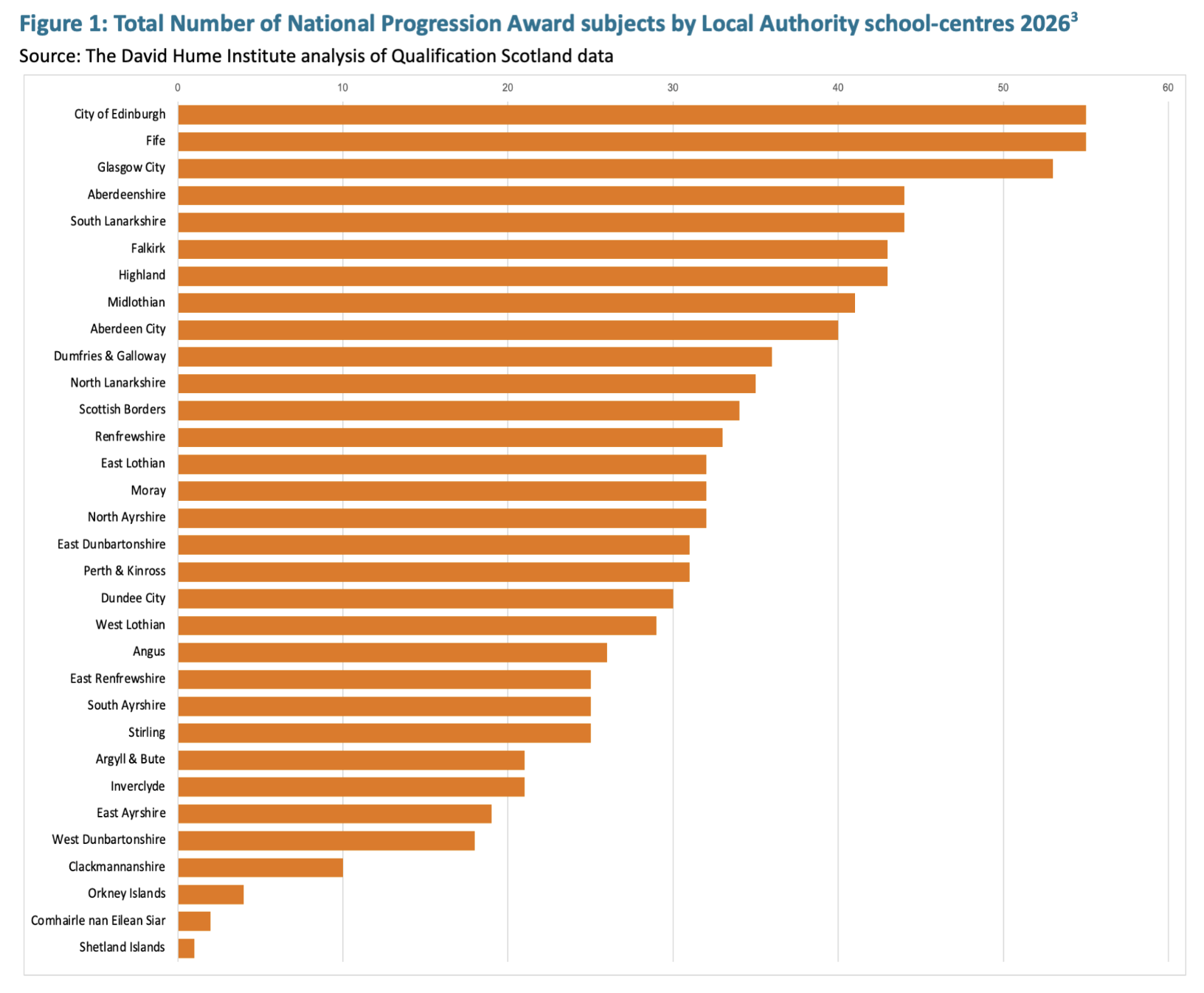
These figures do not prove that pupils in areas with fewer recorded subjects have less access. NPAs may also be delivered through colleges and partnership arrangements, which are not possible to fully capture in the geographical analysis. However, with 267 possible NPA subjects across different levels and educational settings, the absence of a comprehensive national picture makes it difficult to establish whether young people have genuinely equal opportunities.
The findings raise important questions about how Scotland will deliver the ambitions of the Hayward Review of Qualifications and Assessment, which called for all senior phase learners to have an entitlement to a broad range of academic, vocational, professional and technical learning.
Ellie Craig, lead researcher on the briefing, said:
"Scotland has made real progress in broadening the qualifications available to young people. The growth in National Progression Awards shows that schools are embracing different ways for pupils to develop practical skills and explore subjects beyond the traditional academic curriculum.
"But the number of qualifications being delivered is not the same as equality of opportunity. We need to know what young people can actually access, whether they can travel or connect to provision elsewhere, and whether the qualifications they work hard to achieve will be recognised when they move on.
"Flexibility is essential to a modern senior phase. But it must expand young people's choices, not leave their opportunities dependent on where they happen to go to school or live."
A broader curriculum is an economic growth issue
The research comes at a critical time for Scottish education and the economy. The Hayward Review proposed a more flexible senior phase, with a wider range of academic, vocational, professional and technical courses.
The growth of NPAs suggests that elements of this broader approach are already taking shape. The challenge now is to ensure that curriculum flexibility translates into meaningful opportunities for learners and the skills Scotland needs.
Scotland's future economic performance will depend in part on its ability to develop a workforce with the technical, digital, creative and practical capabilities required by changing industries. Young people need opportunities to develop those skills, while employers and universities need to understand the value of the qualifications through which they are demonstrated.
The report highlights the growing importance of subjects such as data science, artificial intelligence and cyber security. Yet recorded school attainment in Data Science was present in only eight of Scotland's 32 local authorities in 2026.
The research also finds that further education colleges recorded 285 Data Science awards at SCQF levels 4–6, in addition to 155 through school centres. This illustrates both the importance of college provision and why a school-only picture cannot tell the whole story.
Ellie Craig added:
"Implementing the Hayward Review is not simply about giving young people more qualifications to choose from. It is about developing the skills Scotland's economy will need in the future.
"Businesses need people with a wider range of capabilities, including digital, technical and problem-solving skills. If Scotland wants to become more productive, innovative and competitive, we need to make sure young people can access these learning opportunities and that employers and universities understand the value of the qualifications they achieve.
"Where a young person lives should not determine the range of skills they can develop or whether those skills are recognised."
Young people need to know their qualifications will count
The report also identifies uncertainty about how universities recognise NPAs in their admissions processes.
Some universities accept particular NPAs towards entry requirements for specific degree courses, but recognition varies by institution, subject and qualification. The Institute argues that learners, parents and teachers need clearer information about how individual awards contribute to progression into higher education and other destinations.
The issue is not simply theoretical. One current S5 pupil who spoke to the researchers described feeling dismissed when asking university admissions staff whether their Level 6 NPAs would be recognised.
Adam said:
"I've been to a couple of open days this year. I've got good grades at Nat 5 and took NPAs alongside my other subjects. I am doing the same with my Highers as I love the NPA subjects.
"But I felt completely dismissed by admissions staff at the two universities I have visited, when I asked if they recognised level 6 NPAs for UCAS points. When I spoke to the Head of Sociology and Criminology at one university, he said he had no awareness of how the Criminology NPA is treated by their admission process. At the other university, they said they would ignore my NPAs."
The findings are also relevant to the forthcoming final report of the UK Government's Milburn Review into Young People and Work, which is examining the reasons behind rising numbers of young people not in education, employment or training.
The review is taking a wider look at the relationship between education, skills, health, welfare and employment. The David Hume Institute's research highlights one important part of that picture: young people need access to relevant learning opportunities, and clear routes from those opportunities into further study, training and work.
Jocelyne Fleming of the Chartered Institute of Building (CIOB) said:
"National Progression Awards are an integral part of Scotland's education and skills landscape, and the geographical variation highlighted by the David Hume Institute raises important questions about equity of opportunity.
"Greater transparency would also help us understand whether the pathways available are working for learners, employers and Scotland's future skills needs. At a time when sectors including construction face significant workforce challenges, we need to understand not simply which qualifications are being delivered, but how they connect to further training, apprenticeships and employment."
The Institute argues that stronger relationships between schools, colleges, universities and employers are essential if Scotland for better opportunities for young people and a more productive economy.
Four recommendations to make pathways clearer and fairer
The report calls on the Scottish Government to work with local authorities, schools, colleges, Qualifications Scotland, the SCQF Partnership and universities to:
Improve transparency: Publish a consistent national picture of NPA provision and attainment across schools, colleges and partnership arrangements.
Support collaboration: Evaluate regional, online and college-school delivery models to extend access to specialist subjects, particularly where local capacity is limited.
Clarify progression: Work with universities and colleges to publish clear, course-specific information about NPA recognition and entry requirements.
Monitor equity and emerging skills: Develop indicators to identify geographical differences in provision and participation, including whether staffing, resources or delivery arrangements constrain access to specialist and emerging-skills subjects.
The report concludes that the objective should not be to make every school's curriculum identical, but to ensure that local flexibility expands opportunity rather than inadvertently limiting it.
Ellie Craig said:
"Scotland is building a more flexible and relevant senior phase that recognises different talents and prepares young people for a changing economy.
"The priority now should be to understand where provision is working, where barriers remain and how successful approaches can be shared. Listening to young people about their experiences must be central to that work.
"Every young person should be able to make informed choices about their future, with confidence that the learning they undertake will be recognised and valued."
ENDS
Notes to editors
Unequal Pathways? Access to National Progression Awards in Scotland is a research briefing by the David Hume Institute, authored by Ellie Craig and Susan Murray.
The research analyses Qualifications Scotland provisional attainment statistics for 2022–2026.
The geographical analysis counts distinct NPA subjects with recorded school-centre attainment in each local authority. It does not include FE college-centre attainment in the geographical comparison and therefore does not provide a complete measure of learner access.
The Hayward Review, It's Our Future: Report of the Independent Review of Qualifications and Assessment, was published in June 2023.
Alan Milburn's independent review into Young People and Work is examining the drivers of rising numbers of young people not in education, employment or training. Its final report is expected in November 2026.
Sharing Thumbnail Image: Photo by Ivan Aleksic free licence from Unsplash on 4th November 2026

Scotland’s Enlightenment Legacy Inspires a New Approach to Maths Education
Maths Expert comments on the David Hume Institute briefing highlighting the importance of practical mathematical reasoning, confidence and real-world problem-solving.
Published: 26th October 2026
Maths expert, David Pritchard, comments on the David Hume Institute briefing highlighting the importance of practical mathematical reasoning, confidence and real-world problem-solving.
A rapid uptake of a new Scottish mathematics qualification is helping more young people develop the skills to apply mathematical knowledge to real-world challenges, with implications for further education, employment and decision-making in an increasingly data-driven world.
A recent briefing from the David Hume Institute, Applications of Mathematics: A Revolution in Maths Education in Scotland?, highlights the significant growth of Applications of Mathematics at National 5 and Higher levels, and its potential to broaden mathematical participation while developing skills that are increasingly important in further study and work.
The growth raises important questions about how mathematical capability is understood, how young people are prepared for further study, and which skills they need to navigate a world increasingly shaped by data and artificial intelligence.
Mathematics for a changing world
Mathematician, David Pritchard, who helped to develop the curriculum for Higher Applications of Mathematics, challenges anyone who says it is an easy option. He said:
“When we developed Higher Applications of Mathematics, it was essential to create a course that was a Higher in its own right. It’s not a lesser version of Higher Mathematics, any more than Higher Chemistry is a lesser version of Higher Physics, or Higher Italian is a lesser version of Higher Latin.
“The aim was to create a qualification with its own intellectual challenge, rigour and value, developing a different but equally important set of mathematical capabilities.
“Mathematics is not only a set of technical tools, important as those are. It is also about choosing which tools to use, understanding what the results are telling you, and applying what you know to a situation you have not encountered before.
“That ability to transfer knowledge between contexts is a sophisticated skill. It requires robust number-sense, the confidence to tackle unfamiliar problems, and the judgement to recognise whether an answer is reasonable.”
Applications of Mathematics develops skills that are relevant to a wide range of further study and careers, including social sciences, nursing, financial services and other fields where people must interpret evidence, understand risk, work with data and make sound judgements under pressure.
These capabilities are not simply about making mathematics more accessible. They are about equipping learners to use it effectively in the situations they will encounter beyond the classroom.
The qualification also develops practical capabilities such as mathematical modelling, project planning, data analysis and the use of spreadsheets and statistical software - skills relevant across sectors, including financial services and healthcare.
Applications is part of Scottish Enlightenment tradition
The ability to assess whether a mathematical result makes sense is becoming particularly important in our rapidly changing world and as artificial intelligence tools become more widely used.
Pritchard said:
“As workers, as consumers, and most of all as citizens, our world is shaped by the use and misuse of numbers. We need people who can look at numerical statements, and ask: does this make sense?
Can you recognise when the assumptions are wrong, when the numbers are implausible, or when a claim simply doesn't follow from the evidence?
Can you apply what you know to test an answer rather than accepting it because it looks authoritative? We need people with the mathematical skills and confidence to see when the numbers don't add up, and to ask, why?
Higher Applications of Mathematics sits solidly in the Scottish Enlightenment tradition of “useful knowledge”. We need maths used critically, the way history or English or science might be used to interrogate the world around us and the claims people make about it. Applications of Mathematics helps develop that critical ability.”
Broadening participation in mathematics
The Institute’s research highlights the importance of connecting education with the skills people need throughout their lives. Applications of Mathematics offers an example of how curriculum design can broaden opportunities while maintaining meaningful academic challenge.
Susan Murray, Director of the David Hume Institute, said:
“The growth of Applications of Mathematics is an important development in Scottish education. It shows that there is a real appetite for mathematical learning that connects with the world young people inhabit and the futures they want to pursue.
“The ability to apply mathematical knowledge, interpret data and make sound judgements is essential for further study, employment and everyday life.
“As the economy changes and AI becomes more prevalent, these skills will become even more important. We need to ensure that parents, employers, universities and policymakers understand the value of Applications of Mathematics and the capabilities it develops.
“As Scotland considers how best to prepare young people for further education and a changing labour market, Applications of Mathematics provides an important example of how mathematical education in school is evolving to meet demand.
About Dr David Pritchard
Dr David Pritchard was born in Edinburgh and attended Balerno High School before studying mathematics at King’s College, University of Cambridge. He completed a PhD and postdoctoral research at the University of Bristol and the University of Cambridge. His academic research focused on applied mathematics, particularly environmental and geological fluid dynamics, sediment transport, non-Newtonian fluids and processes in porous media.
He joined the University of Strathclyde’s Department of Mathematics and Statistics in 2006. Alongside his university teaching, which includes teaching Mathematics and society, David has made a substantial contribution to the development of school mathematics education in Scotland.
Following his work on Higher Applications of Mathematics, he led a Scottish Funding Council-supported professional development module in mathematical modelling to help teachers prepare to deliver the new qualification. He has also contributed to online mathematics resources through the SCHOLAR project.
David’s work reflects a strong commitment to presenting mathematics as a discipline of reasoning, problem-solving and practical application. He believes that mathematical education should equip learners not only to perform calculations, but also to apply knowledge in unfamiliar contexts, interpret quantitative information and judge whether results make sense. His work on Applications of Mathematics has sought to broaden the mathematical opportunities available to young people while ensuring that the qualification maintains the academic rigour and standing of a Higher in its own right.
His wider contribution to mathematics education includes serving as Convenor of the Edinburgh Mathematical Society’s Education Committee from 2011 to 2015, representing the Society on the Joint Mathematical Council of the UK from 2014 to 2019, and serving as a trustee of the Council from 2017 to 2019. He was also a member of the Scottish Mathematical Council from 2015 to 2021 and contributed to the Royal Society of Edinburgh’s Learned Societies’ Group on Scottish STEM Education.
David has extensive experience in mathematical outreach and enrichment, including work with the UK Mathematics Trust’s Mathematical Circles, the Scottish Mathematical Challenge and Techfest-SetPoint’s Maths in the Pipeline programme. Across these activities, he has championed approaches that help young people experience mathematics as an engaging process of discovery and problem-solving.
His combination of mathematical expertise, university teaching experience, curriculum design and sustained engagement with teachers and professional bodies gives him a distinctive perspective on how Scotland can develop mathematical capability, strengthen pathways through education and help learners use mathematics confidently in further study, employment and everyday life.

Scotland’s Budget: Focus on What Spending Delivers, Not Just How Much It Costs
DHI’s submission to the Scottish Parliament’s Economy, Tourism and Energy Committee’s pre-Budget scrutiny asks not how much the country can afford to spend, but what can Scotland afford not to invest in?
The David Hume Institute has called for a more strategic approach to Scotland’s economic spending, arguing that public investment must be judged by the economic capacity it creates, not simply the amount of money spent.
In its submission to the Scottish Parliament’s Economy, Tourism and Energy Committee’s pre-Budget scrutiny for 2027–28, the Institute argues that constrained public finances make it more important than ever to prioritise investment that strengthens productivity, encourages business investment and innovation, supports employment and improves living standards.
With public spending under pressure and funding for the economy, tourism and energy portfolios expected to fall in real terms, the Institute argues that across-the-board reductions risk overlooking investments that could deliver significant long-term benefits.
Instead, the Government should assess major programmes against clear criteria: what problem are they intended to solve, why is public intervention necessary, what would happen without it, and what lasting economic benefits will they generate?
The submission identifies five priorities:
Improving productivity and business investment
Developing infrastructure that enables economic activity
Making better use of people’s skills
Strengthening innovation and economic resilience
Ensuring Scotland’s energy transition creates lasting benefits for domestic businesses and workers.
It also calls for a more rigorous approach to evaluating public spending. Counting businesses supported, projects delivered or visitors attracted tells only part of the story. Policymakers must also establish what changed as a result of spending, whether benefits would have occurred anyway, and how much economic value was retained in Scotland.
Crucially, the Institute argues that economic performance cannot be considered in isolation from other policy areas. Housing, transport, skills, financial wellbeing, energy and planning all influence productivity and investment.
The submission’s central message is that Scotland needs a longer-term perspective on public finances, recognising the trade-offs between immediate spending pressures and investments whose benefits may take years to emerge.
As the Institute concludes, the question for Scotland’s 2027–28 Budget should not simply be how much the country can afford to spend, but what can Scotland afford not to invest in?

Rapid growth of learners in Scotland embracing real world skills
New briefing paper on the rapid growth of practical qualifications show Scottish learners embracing real world skills
Attainment in National Progression Awards has more than doubled since 2022, prompting calls for more awareness about new qualifications.
Wednesday 23rd September 2026
A new briefing from The David Hume Institute shows a significant shift in how learners in Scotland build practical work-ready skills alongside traditional exams.
The paper, “The Changing Landscape of Education in Scotland: A New National Progression?” reveals that attainment of National Progression Awards (NPAs) - qualifications typically assessed continuously throughout the year rather than in a final high stakes exam, has more than doubled from 19,640 in 2022 to 44,0303 in 2026.
NPAs now span more than 267 subject areas including cyber security, data science, sports leadership and health care. They are increasingly being delivered in-house by secondary schools across Scotland to broaden choices and learning in the senior phase.
This growth reflects the recommendations of the Hayward Review which was commissioned by the Scottish Government and published in 2023. The trend mirrors that in other countries highlighted in the OECD’s 2026 report, A Skills First Labour Market which calls on education systems across the globe to focus on practical, transferable skills that directly support employability and economic opportunity.
Susan Murray, Director of the David Hume Institute, said:
“The rapid growth of National Progression Awards means thousands more young people are now gaining skills and qualifications through a different model of learning and assessment, often alongside traditional National 5s and Highers.
“This is a significant change that more people, especially employers, need to understand. NPAs are helping develop practical skills and are part of the changing education landscape in Scotland. This development seems to have gone largely unnoticed in public discussion about education and youth employment in a rapidly changing jobs market.
“Continuing to develop NPAs raises important questions about how we recognise skills, how we design the senior phase and how qualifications connect young people with continuing education and employment.”
The new briefing identifies curriculum flexibility, the growing relevance of practical and job-ready skills, and increased delivery of NPAs directly within secondary schools as factors behind their growth.
The briefing also highlights challenges accompanying the expansion of NPAs. Access to particular subjects varies across Scotland, while employers and recruiters will need to understand an increasingly diverse qualifications landscape. Schools and colleges are using approaches such as cluster-school provision, college partnerships and online tutoring to broaden access.
The growth of National Progression Awards is highly relevant to the upcoming Milburn Review publication because it shows that changes to how young people develop skills, are assessed and connected to future jobs are already underway in Scotland.
Susan Murray, Director of The David Hume Institute added
“The Milburn Review is considering how we can better prepare more young people for further education, employment and a changing labour market. NPAs provide an important part of the jigsaw in Scotland, with a focus on practical skills with standards set by trade and professional bodies.
“This development should not be overlooked. Whatever conclusions the Milburn Review reaches, it is important to understand the rapid change already underway in Scottish schools.”
Quotes from the briefing
Mr Meikle, Headteacher at Craigmount High School said:
“Our school delivers a wide range of NPAs both in-house and in partnership with the local college. Last year pupils at Craigmount achieved over 4000 qualifications - 7% were NPAs and 176 were Level 6 NPAs.
“NPA courses are popular with pupils because they can see their progress with regular assessment and choose subjects directly related to careers they wish to pursue or new subjects that interest them. Subjects range from business and marketing to web design and cyber security, and give a good grounding in developing skills required for life after school.”
A 2026 NPA Student said:
“I did mainly Nat 5's, and one NPA. Doing the NPA was just as much work, but it was spread out more during the year, so I had one less subject to worry about at exam time. I really enjoyed the NPA, partly because I liked the subject, and also because you could really get into something rather than constantly revising previous topics for an exam at the end of the year so I got really immersed in it.“
A 2026 NPA Parent said:
“My son chose an NPA because he was interested in the subject, rather than because it was an NPA. But being an NPA was a real positive. The work was assessed during the year, which felt much fairer than basing the assessment on one exam at the end. And it reduced the pressure a bit, when he was sitting his Nat 5 exams, as he had one less to revise for.”
Thumbnail photo credit: X on Unsplash, downloaded free on 17.9.26