

Rapid growth of learners in Scotland embracing real world skills
New briefing paper on the rapid growth of practical qualifications show Scottish learners embracing real world skills
Wednesday 23rd September 2026
Attainment in National Progression Awards has more than doubled since 2022, prompting calls for more awareness about new qualifications.
A new briefing from The David Hume Institute shows a significant shift in how learners in Scotland build practical work-ready skills alongside traditional exams.
The paper, “The Changing Landscape of Education in Scotland: A New National Progression?” reveals that attainment of National Progression Awards (NPAs) - qualifications typically assessed continuously throughout the year rather than in a final high stakes exam, has more than doubled from 19,640 in 2022 to 44,0303 in 2026.
NPAs now span more than 267 subject areas including cyber security, data science, sports leadership and health care. They are increasingly being delivered in-house by secondary schools across Scotland to broaden choices and learning in the senior phase.
This growth reflects the recommendations of the Hayward Review which was commissioned by the Scottish Government and published in 2023. The trend mirrors that in other countries highlighted in the OECD’s 2026 report, A Skills First Labour Market which calls on education systems across the globe to focus on practical, transferable skills that directly support employability and economic opportunity.
Susan Murray, Director of the David Hume Institute, said:
“The rapid growth of National Progression Awards means thousands more young people are now gaining skills and qualifications through a different model of learning and assessment, often alongside traditional National 5s and Highers.
“This is a significant change that more people, especially employers, need to understand. NPAs are helping develop practical skills and are part of the changing education landscape in Scotland. This development seems to have gone largely unnoticed in public discussion about education and youth employment in a rapidly changing jobs market.
“Continuing to develop NPAs raises important questions about how we recognise skills, how we design the senior phase and how qualifications connect young people with continuing education and employment.”
The new briefing identifies curriculum flexibility, the growing relevance of practical and job-ready skills, and increased delivery of NPAs directly within secondary schools as factors behind their growth.
The briefing also highlights challenges accompanying the expansion of NPAs. Access to particular subjects varies across Scotland, while employers and recruiters will need to understand an increasingly diverse qualifications landscape. Schools and colleges are using approaches such as cluster-school provision, college partnerships and online tutoring to broaden access.
The growth of National Progression Awards is highly relevant to the upcoming Milburn Review publication because it shows that changes to how young people develop skills, are assessed and connected to future jobs are already underway in Scotland.
Susan Murray, Director of The David Hume Institute added
“The Milburn Review is considering how we can better prepare more young people for further education, employment and a changing labour market. NPAs provide an important part of the jigsaw in Scotland, with a focus on practical skills with standards set by trade and professional bodies.
“This development should not be overlooked. Whatever conclusions the Milburn Review reaches, it is important to understand the rapid change already underway in Scottish schools.”
Quotes from the briefing
Mr Meikle, Headteacher at Craigmount High School said:
“Our school delivers a wide range of NPAs both in-house and in partnership with the local college. Last year pupils at Craigmount achieved over 4000 qualifications - 7% were NPAs and 176 were Level 6 NPAs.
“NPA courses are popular with pupils because they can see their progress with regular assessment and choose subjects directly related to careers they wish to pursue or new subjects that interest them. Subjects range from business and marketing to web design and cyber security, and give a good grounding in developing skills required for life after school.”
A 2026 NPA Student said:
“I did mainly Nat 5's, and one NPA. Doing the NPA was just as much work, but it was spread out more during the year, so I had one less subject to worry about at exam time. I really enjoyed the NPA, partly because I liked the subject, and also because you could really get into something rather than constantly revising previous topics for an exam at the end of the year so I got really immersed in it.“
A 2026 NPA Parent said:
“My son chose an NPA because he was interested in the subject, rather than because it was an NPA. But being an NPA was a real positive. The work was assessed during the year, which felt much fairer than basing the assessment on one exam at the end. And it reduced the pressure a bit, when he was sitting his Nat 5 exams, as he had one less to revise for.”
Thumbnail photo credit: X on Unsplash, downloaded free on 17.9.26

Practical Maths opens doors to higher education for Scottish pupils this results day
New data released highlights how a new qualification, Applications of Mathematics, is opening doors for young people into higher education and employment.
4th August 2026
As thousands of young people across Scotland receive their exam results today, new figures highlight how Applications of Maths qualifications continue to open doors that lack of traditional maths once blocked.
As the national #NoWrongPath campaign celebrates the diverse routes young people can take to achieve their goals, new data released today by Qualifications Scotland underlines the important role played by the new Applications of Mathematics qualifications at National 5 and Higher levels in widening access to higher education and future employment.
Today, new figures show that entries into Applications of Mathematics are continuing to increase. The National 5 qualification has grown signifcantly from 4,460 entries in 2019 to 30,045 in 2026. In Higher Applications of Mathematics there was an increase in the number of entries from only 868 entries in 2022 to 7,025 in 2026.
Traditional, “more abstract”, mathematics courses have historically been a stumbling block for some otherwise capable pupils, in some cases even preventing them from fulfilling university entry requirements. The Applications of Mathematics curriculum offers a new way of learning about maths focusing on practical, real-world skills like budgeting, taxation and data analysis.
The David Hume Institute has published a briefing which reveals how the course is increasing uptake of mathematics, whilst serving as a vital bridge into higher education and work for pupils who previously struggled with algebra and theoretical maths.
Opening Doors to Higher Education
For many pupils, achieving a pass in National 5 or Higher Applications of Mathematics is the key that unlocks their choices at college, university or apprenticeship.
Abi, a 2026 University Graduate, shared how the qualification changed her career trajectory:
“I have just graduated with a degree in Community Education. I struggled with traditional maths at Nat 5 but Apps helped me develop skills I needed for university, and life. Without Applications of Maths I wouldn't have been eligible for the course. It really is a much needed bridge for young people like me.”
Susan Murray, Director of the David Hume Institute, said:
“Results Day brings a mix of excitement and trepidation. The new Applications of Mathematics curriculum is expanding the pathways to success by giving more young people practical, usable skills for life and work. The relevance of real world maths encourages perseverance ensuring a struggle with abstract algebra does not keep talented young people out of university or the workforce.”
Preparing Young People for the Real World
The new qualification directly aligns with the ethos of #NoWrongPath by recognising that employers and higher education institutions are increasingly placing more value on practical skills such as financial literacy and data handling.
Johnny Timpson, Commissioner, Financial Inclusion Commission said:
"I’m hugely supportive of the development of the Applications of Mathematics curriculum. Stronger financial capability is key to improving people's career opportunities and is also linked to improved well being and resilience to shocks for people of all ages."
Leon Ward, Chief Executive of charity Money Ready, said:
“This is the kind of content that financial literacy advocates have been arguing should be embedded in the curriculum for years.”
David McCulloch, High School Mathematics Teacher said:
"As a teacher, we regularly have conversations with young people and their families about N5 and Higher Apps. There are key skills in the Higher course which are very relevant to careers in financial services such as mathematical modelling, project planning and the use of Excel and statistical software."
Looking Ahead
As the conversation continues at a national level around education reform and attainment gaps, evidence suggests that the Applications of Mathematics curriculum is increasing opportunities for learning to be connected with real world opportunities.
The David Hume Institute recognises the need for greater awareness of the qualification among young people, parents, employers, universities and policymakers. While Applications of Mathematics is now well established in schools, many outside education remain unfamiliar with the qualification and the opportunities it provides for learners.
ENDS -
Sharing thumbnail image credit: Photo by Aaron Lefler free from Unsplash 3 August 2026
New briefing reveals growth in maths education in Scotland
Since its introduction in 2019, entries increased sixfold in six years in new maths qualification which is helping drive a significant rise in the number of young people studying mathematics.
24th July 2026
Sixfold increase in entries suggests the new maths qualification is attracting thousands more young people into mathematics
A new briefing paper, published by the David Hume Institute, reveals that Scotland's National 5 Applications of Mathematics qualification has experienced extraordinary growth. Since its introduction in 2019, entries increased sixfold in six years and it is helping drive a significant rise in the number of young people studying mathematics.
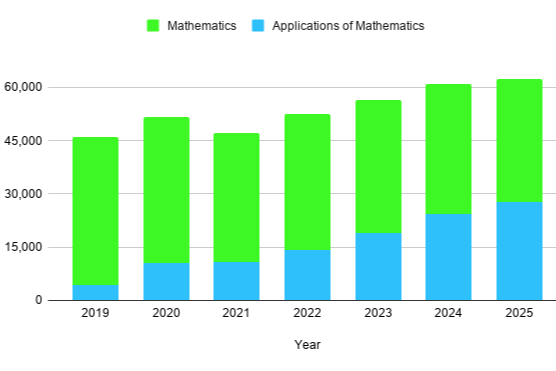
National 5 Entries into Mathematics and Applications of mathematics
The briefing, Applications of Mathematics: A Revolution in Maths Education in Scotland? shows that National 5 Applications of Mathematics entries rose from 4,460 in 2019 to 27,655 in 2025.
The qualification is now the third most popular National 5 examination in Scotland, behind only English and traditional Mathematics. Together, Applications of Mathematics and traditional Mathematics have contributed to an increase of over a third in the number of pupils taking a National 5 maths qualification.
The paper argues that the qualification represents an important innovation in Scottish education by focusing on practical mathematical skills that young people use in everyday life - including budgeting, taxation, personal finance, loans, interest rates and interpreting data - while also supporting the skills increasingly sought by employers in sectors such as financial services and data science.
Young people who spoke to the David Hume Institute as part of the research said:
“I like Maths Apps because I can see why I need it in the real world.” High School Student
“I hated algebra and normal maths but Applications of Maths feels like stuff I’ll need in my life.” High School Student
Overall participation in mathematics has increased by more than a third and rather than replacing traditional mathematics, the evidence suggests the qualification is broadening participation. Some pupils are choosing to study both qualifications at National 5.
There has also been a rapid growth in Higher Applications of Mathematics since its introduction in 2022 - from 868 entries in 2022 to 4,682 in 2025 - demonstrating increasing demand for the qualification that combines mathematical reasoning with practical statistical and financial skills.
Susan Murray, Director of the David Hume Institute, said:
"Applications of Mathematics is an important development which is rapidly growing the number of people studying maths. The practical mathematical skills are helping equip more young people with the skills they need for modern life and work.
“From our past research on The Great Risk Transfer we know how important financial literacy is throughout our lives. This new curriculum helps develop those much needed skills."
Johnny Timpson, Commissioner, Financial Inclusion Commission said
"I’m hugely supportive of the development of the Applications of Mathematics curriculum. Stronger financial capability is key to improving people's career opportunities and is also linked to improved well being and resilience to shocks for people of all ages"
Leon Ward, Chief Executive of charity Money Ready, said:
“This is the kind of content that financial literacy advocates have been arguing should be embedded in the curriculum for years.”
The briefing also draws attention to the need for greater awareness of the qualification among parents, employers, universities and policymakers. While Applications of Mathematics is now well established in schools, many outside education remain unfamiliar with the qualification and the opportunities it provides for learners.
David McCulloch, High School Mathematics Teacher said:
"As a teacher, we regularly have conversations with young people and their families about N5 and Higher Apps. There are key skills in the Higher course which are very relevant to careers in financial services such as mathematical modelling, project planning and the use of Excel and statistical software."
Abi, 2026 Graduate said:
"I have just graduated with a degree in Community Education. I struggled with traditional maths at Nat 5 but Apps helped me develop skills I needed for university, and life. Without Applications of Maths I wouldn't have been eligible for the course. It really is a much needed bridge for young people like me.“
As conversations continue around financial literacy, workforce skills and curriculum reform, the paper concludes that Applications of Mathematics offers an important piece of the jigsaw for how education can better connect classroom learning with real-world challenges and future employment.
ENDS -
Sharing thumbnail image credit: Photo by Ben Mullins free from Unsplash 23 July 2026